Botany
Carnivorous plant
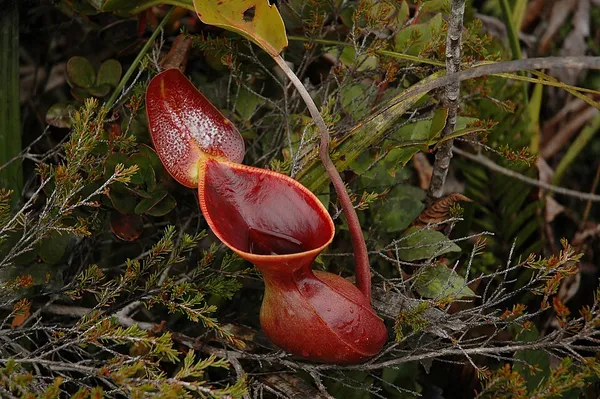
Carnivorous plants are plants that derive some or most of their nutrients from trapping and consuming animals or protozoans, typically insects and other arthropods, and occasionally small mammals and birds. They have adapted to grow in waterlogged sunny places where the soil is thin or poor in nutrients, especially nitrogen, such as acidic bogs. They can be found on all continents except Antarctica, as well as many Pacific islands. In 1875, Charles Darwin published Insectivorous Plants, the first treatise to recognize the significance of carnivory in plants, describing years of his research. True carnivory is believed to have evolved independently at least 12 times in five different orders of flowering plants, and is represented by more than a dozen genera. This classification includes at least 583 species that attract, trap, and kill prey, absorbing the resulting available nutrients. Venus flytraps (Dionaea muscipula), pitcher plants, and bladderworts (Utricularia spp.) can be seen as exemplars of key traits genetically associated with carnivory: trap leaf development, prey digestion, and nutrient absorption. There are at least 800 species of carnivorous plants. The number of known species has increased by approximately 3 species per year since the year 2000. Additionally, over 300 protocarnivorous plant species in several genera show some but not all of these characteristics. A 2020 assessment has found that roughly one quarter are threatened with extinction from human actions.
Also on this shelf
Fungus Rock.
Colutea.
See also
Uncatalogued shelfText from Wikipedia; plate via Wikimedia Commons. Text CC BY-SA 4.0; plate freely licensed (see Commons). Source record. Images and catalogue data are reproduced from open-access collections.