Botany
Coriaria
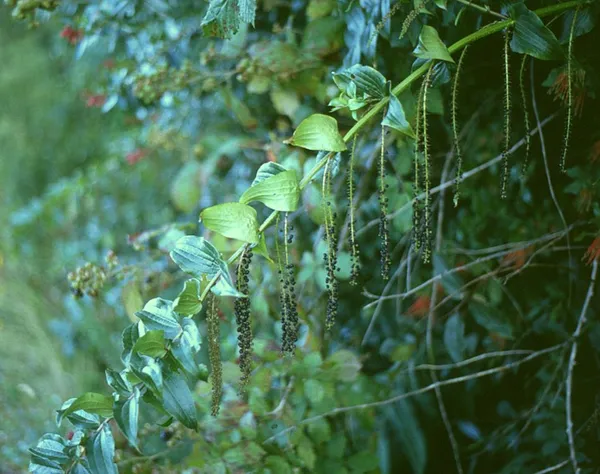
Coriaria is the sole genus in the family Coriariaceae, which was described by Linnaeus in 1753. It includes 14 species of small trees, shrubs and subshrubs, with a widespread but disjunct distribution across warm temperate regions of the world, occurring as far apart as the Mediterranean region, southern and eastern Asia, New Zealand (where some are alpine species), the Pacific Ocean islands, and Central and South America. The leaves are opposite or in whorls, simple, 2–9 centimetres (0.79–3.54 inches) long, without stipules. The flowers are borne in racemes 2–30 cm long, each flower small, greenish, with five small petals. The fruit is a small and shiny black (occasionally yellow or red) berry-like swollen corolla, highly poisonous in several species, though those of C. terminalis are edible. At least a few members of this genus are non-legume nitrogen fixers. The Mediterranean species C. myrtifolia is known as redoul, and the several New Zealand species are known by the Māori name of tutu. The South American species C. ruscifolia is an evergreen climber known as deu or huique, and is used in southern Chile to make rat poison.
Also on this shelf
Exocarya.
Euphorbia characias.
See also
Uncatalogued shelfText from Wikipedia; plate via Wikimedia Commons. Text CC BY-SA 4.0; plate freely licensed (see Commons). Source record. Images and catalogue data are reproduced from open-access collections.