Botany
Ammophila (plant)
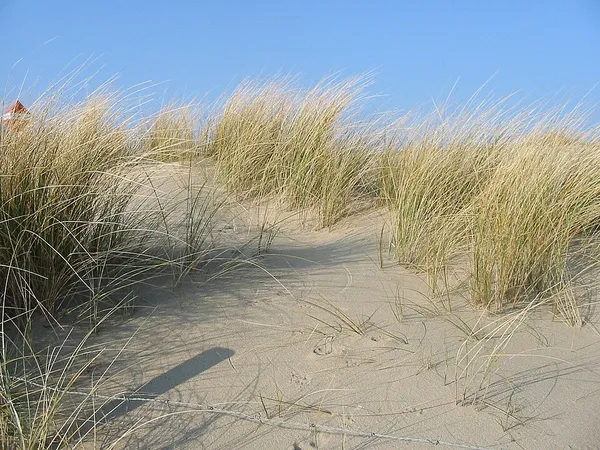
Ammophila (synonymous with Psamma P. Beauv.) is a genus of flowering plants consisting of two or three very similar species of grasses. The genus name Ammophila originates from the Greek words ἄμμος (ámmos), meaning "sand", and φίλος (philos), meaning "friend". The common names for the grasses include marram grass, bent grass, and beachgrass. The grasses are found almost exclusively on the first line of coastal dunes. Their extensive system of creeping underground stems or rhizomes allows them to thrive under conditions of shifting sands and high winds, and helps stabilize the dunes and prevent coastal erosion. Ammophila species are native to the coasts of the North Atlantic Ocean where they are usually the dominant species on dunes. Their native range includes few inland regions, with the Great Lakes of North America being the main exception. The Ammophila grasses are widely known as examples of xerophytes, plants that can withstand dry conditions. Despite their occurrence on seacoasts, Ammophila grasses are not particularly tolerant of saline soils, although they can tolerate a salinity of about 15 g/L (1.5%), which makes them "moderate halophytes". Ammophila builds coastal dunes and thus stabilizes the sand. For that reason, the plants are seen as a useful means of reinforcing dunes around the world and have been introduced far from their native range. Alfred Wiedemann writes that Ammophila arenaria, the European species, "has been introduced into virtually every British colonial settlement within its latitudinal tolerance range, including south-east and south-west Australia, New Zealand, South Africa, the Falkland Islands, and Norfolk Island, and has been reported from Argentina and Chile." Ammophila species were introduced in the late 19th century on the Pacific coast of North America as well, and massive, intentional plantings were continued at least through 1960. In Oregon, the initial planting of European marram grass to stabilize sand dunes began in the early 20th century, with heavy implementation between 1910 and 1935. The resulting ecological impacts and habitat alterations have developed over several decades. Introduced to the Oregon coast for erosion control, it spread uncontrollably, replacing native vegetation and weakening natural storm protection.
Also on this shelf
Camptacra.
Alternanthera bettzickiana.
See also
Uncatalogued shelfText from Wikipedia; plate via Wikimedia Commons. Text CC BY-SA 4.0; plate freely licensed (see Commons). Source record. Images and catalogue data are reproduced from open-access collections.