Astronomy and Space
Evidence of water on Mars found by Mars Reconnaissance Orbiter
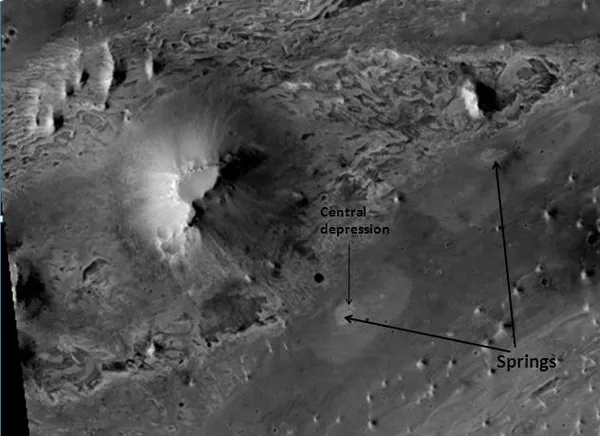
The Mars Reconnaissance Orbiter's HiRISE instrument has taken many images that strongly suggest that Mars has had a rich history of water-related processes. Many features of Mars appear to be created by large amounts of water. That Mars once possessed large amounts of water was confirmed by isotope studies in a study published in March 2015, by a team of scientists showing that the ice caps were highly enriched with deuterium, heavy hydrogen, by around seven times as much as the Earth. This means that Mars had lost a volume of water 6.5 times what is stored in today's polar caps. The water for a time would have formed an ocean in the low-lying Mare Boreum. The amount of water could have covered the planet about 140 meters, but was probably in an ocean that in places would be almost 1 mile deep. A major discovery by HiRISE was finding evidence of hot springs. These may have contained life and may now contain well-preserved fossils of life.
Also on this shelf
Kappa Cygni.
Beta Aquarii.
See also
- ▸Epsilon Piscium
- ▸Ernakulam–Kollam line (via Kottayam and Kayamkulam)
- ▸Cincinnati Zoo and Botanical Garden
Text from Wikipedia; plate via Wikimedia Commons. Text CC BY-SA 4.0; plate freely licensed (see Commons). Source record. Images and catalogue data are reproduced from open-access collections.