Astronomy and Space
Electromagnetic spectrum
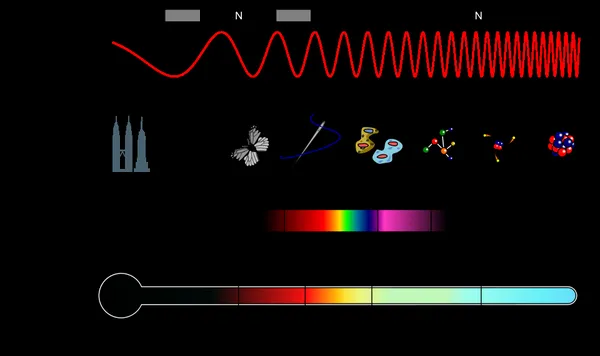
The electromagnetic spectrum is the full range of electromagnetic radiation, organized by frequency or wavelength. The spectrum is divided into separate bands, with different names for the electromagnetic waves within each band. From low to high frequency these are: radio waves, microwaves, infrared, visible light, ultraviolet, X-rays, and gamma rays. The electromagnetic waves in each of these bands have different characteristics, such as how they are produced, how they interact with matter, and their practical applications. Radio waves, at the low-frequency end of the spectrum, have the lowest photon energy and the longest wavelengths—thousands of kilometers, or more. They can be emitted and received by antennas, and pass through the atmosphere, foliage, and most building materials. Gamma rays, at the high-frequency end of the spectrum, have the highest photon energies and the shortest wavelengths—much smaller than an atomic nucleus. Gamma rays, X-rays, and extreme ultraviolet rays are called ionizing radiation because their high photon energy is able to ionize atoms, causing chemical reactions. Longer-wavelength radiation such as visible light is non-ionizing; the photons do not have sufficient energy to ionize atoms. Throughout most of the electromagnetic spectrum, spectroscopy can be used to separate waves of different frequencies, so that the intensity of the radiation can be measured as a function of frequency or wavelength. Spectroscopy is used to study the interactions of electromagnetic waves with matter.
Also on this shelf
Kennedy Space Center Launch Complex 39B.
Carbonates on Mars.
See also
Uncatalogued shelfText from Wikipedia; plate via Wikimedia Commons. Text CC BY-SA 4.0; plate freely licensed (see Commons). Source record. Images and catalogue data are reproduced from open-access collections.