Astronomy and Space
Atlas (rocket family)
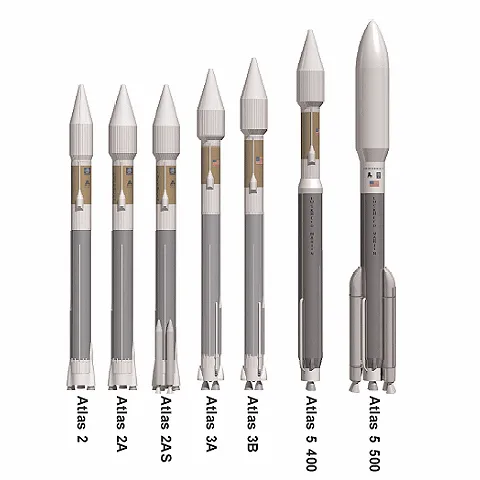
Atlas is a family of US missiles and space launch vehicles derived from the SM-65 Atlas. The Atlas intercontinental ballistic missile (ICBM) program was initiated in the late 1950s by General Dynamics through its Convair division. Atlas was a liquid propellant rocket burning RP-1 kerosene fuel with liquid oxygen in three engines configured in an unusual "stage-and-a-half" or "parallel staging" design: two outboard booster engines were jettisoned along with supporting structures during ascent, while the center sustainer engine, propellant tanks and other structural elements remained connected through propellant depletion and engine shutdown. The Atlas name was originally proposed by Karel Bossart and his design team working at Convair on project MX-1593. Using the name of a mighty Titan from Greek mythology reflected the missile's place as the biggest and most powerful at the time. It also reflected the former parent company of Convair before its General Dynamics acquisition, the Atlas Corporation. The missiles saw only brief ICBM service, and the last squadron was taken off operational alert in 1965. However, from 1962 to 1963 Atlas boosters launched the first four US astronauts to orbit the Earth (in contrast to the preceding two Redstone suborbital launches). The Atlas-Agena and Atlas-Centaur satellite launch vehicles were also derived directly from the original Atlas. The Atlas-Centaur was evolved into the Atlas II, various models of which were launched 63 times between 1991 and 2004. There were only six launches of the succeeding Atlas III, all between 2000 and 2005. The Atlas V is still in service, with launches planned into the mid-2020s. More than 300 Atlas launches have been conducted from Cape Canaveral Space Force Station in Florida and 285 from Vandenberg Space Force Base in California.
Also on this shelf
Kosmos 2251.
Christa McAuliffe.
See also
Uncatalogued shelfText from Wikipedia; plate via Wikimedia Commons. Text CC BY-SA 4.0; plate freely licensed (see Commons). Source record. Images and catalogue data are reproduced from open-access collections.