Astronomy and Space
Comet
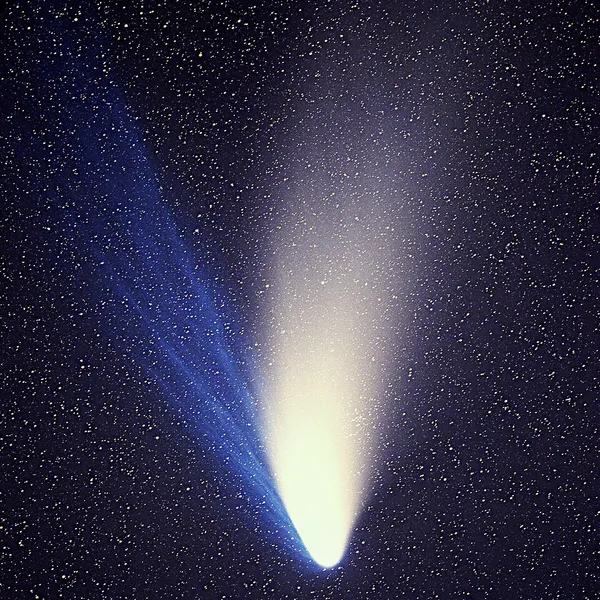
A comet is an icy, small Solar System body or interstellar object that warms and begins to release gases when passing close to the Sun, a process called outgassing. This produces an extended, gravitationally unbound atmosphere or coma surrounding the nucleus, and sometimes a tail of gas and dust gas blown out from the coma. These phenomena are due to the effects of solar radiation and the outstreaming solar wind plasma acting upon the nucleus of the comet. Comet nuclei range from a few hundred meters to tens of kilometers across and are composed of loose collections of ice, dust, and small rocky particles. The coma may be up to 15 times Earth's diameter, while the tail may stretch beyond one astronomical unit. If sufficiently close and bright, a comet may be seen from Earth without the aid of a telescope and can subtend an arc of up to 30° (60 Moons) across the sky. Comets have been observed and recorded since ancient times by many cultures and religions. Comets usually have highly eccentric elliptical orbits, and they have a wide range of orbital periods, ranging from several years to potentially several millions of years. Short-period comets originate in the Kuiper belt or its associated scattered disc, which lie beyond the orbit of Neptune. Long-period comets are thought to originate in the Oort cloud, a spherical cloud of icy bodies extending from outside the Kuiper belt to halfway to the nearest star. Long-period comets are set in motion towards the Sun by gravitational perturbations from passing stars and the galactic tide. Hyperbolic comets may pass once through the inner Solar System before being flung to interstellar space. The appearance of a comet is called an apparition. Comets differ from asteroids. Comets contain volatile material that sublimate as they approach the Sun to produce the characteristic tail, but asteroids are more like rocks and form no tail. Asteroids are thought to have a different origin from comets, having formed inside the orbit of Jupiter rather than in the outer Solar System. However, the discovery of main-belt comets and active centaur minor planets has blurred the distinction between asteroids and comets. In the early 21st century, the discovery of some minor bodies with long-period comet orbits, but characteristics of inner solar system asteroids, were called Manx comets.
Also on this shelf
1I/ʻOumuamua.
Akatsuki (spacecraft).
See also
Uncatalogued shelfText from Wikipedia; plate via Wikimedia Commons. Text CC BY-SA 4.0; plate freely licensed (see Commons). Source record. Images and catalogue data are reproduced from open-access collections.