Astronomy and Space
Ganymede (moon)
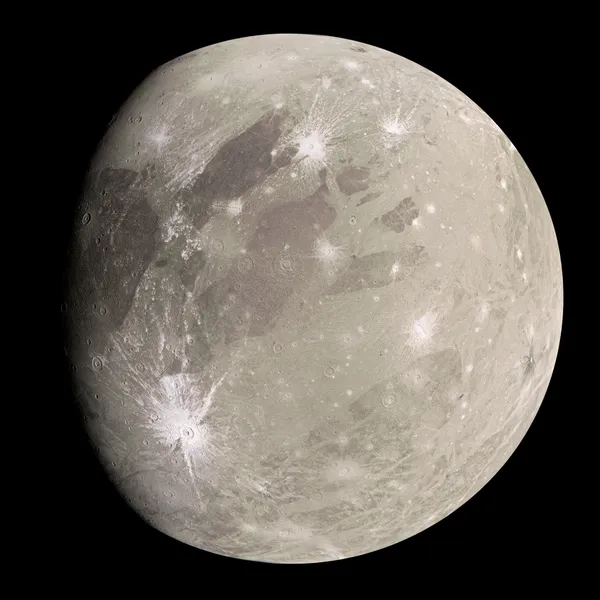
Ganymede is a natural satellite of Jupiter and is the largest and most massive moon in the Solar System. Like Saturn's largest moon, Titan, it is larger than the planet Mercury, but has somewhat less surface gravity than Mercury, Io, or Earth's Moon due to its lower density compared to the three. Ganymede orbits Jupiter in roughly seven days and is in a 1:2:4 orbital resonance with the moons Europa and Io, respectively. Ganymede is composed of silicate rock and water in approximately equal proportions. It is a fully differentiated body with an iron-rich, liquid metallic core, giving it the lowest moment of inertia factor of any solid body in the Solar System. Its internal ocean potentially contains more water than all of Earth's oceans combined. Ganymede is the only natural satellite in the solar system to possess an internally generated magnetic field. It is probably created by convection within its core, and influenced by tidal forces from Jupiter's far greater magnetic field. Ganymede has a thin oxygen atmosphere that includes O, O2, and possibly O3. Atomic hydrogen is a minor atmospheric constituent. Whether Ganymede has an ionosphere associated with its atmosphere is unresolved. Ganymede's surface is composed of two main types of terrain, the first of which are lighter regions, generally crosscut by extensive grooves and ridges, dating from slightly less than 4 billion years ago, covering two-thirds of Ganymede. The cause of the light terrain's disrupted geology is not fully known, but may be the result of tectonic activity due to tidal heating. The second terrain type are darker regions saturated with impact craters, which are dated to four billion years ago. Ganymede's discovery is credited to Simon Marius and Galileo Galilei, who both observed it in 1610, as the third of the Galilean moons, the first group of objects discovered orbiting another planet. Marius soon named it after Ganymede, a Trojan prince desired by Zeus, who carried him off to serve as cupbearer to the gods. Beginning with Pioneer 10, several spacecraft have explored Ganymede. The Voyager probes, Voyager 1 and Voyager 2, refined measurements of its size, while Galileo discovered its underground ocean and magnetic field. The next planned mission to the Jovian system is the European Space Agency's Jupiter Icy Moons Explorer (Juice), which was launched in 2023.
Also on this shelf
EmDrive.
Haumea.
See also
Uncatalogued shelfText from Wikipedia; plate via Wikimedia Commons. Text CC BY-SA 4.0; plate freely licensed (see Commons). Source record. Images and catalogue data are reproduced from open-access collections.