Astronomy and Space
Dragonfly (Titan space probe)
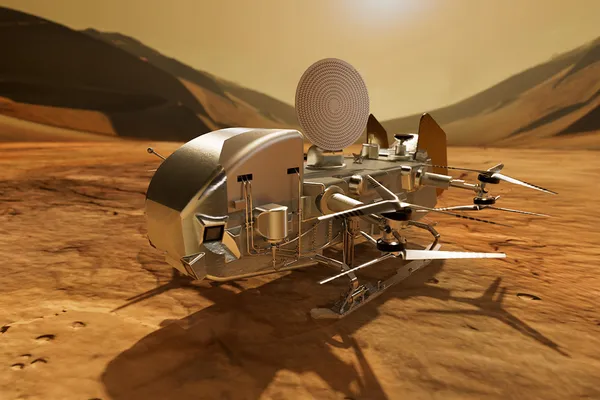
Dragonfly is an upcoming NASA mission to send a robotic rotorcraft to the surface of Titan, the largest moon of Saturn. It is to be launched in July 2028 and arrive in 2034, becoming the first aircraft on Titan. Built to study prebiotic chemistry and extraterrestrial habitability, it is intended to make the first powered and fully controlled atmospheric flight on any natural satellite. It will then use its vertical takeoffs and landings (VTOL) capability to move between exploration sites. Its main mission will last for around three years and could cover 115 km (70 miles) from its original landing site; visiting and landing at 20-30 sites. Titan is the only extraterrestrial body in the Solar System with an abundant, complex, and diverse carbon-rich chemistry and a surface dominated by water ice, with an interior water ocean, making it a high-priority target for astrobiology and origin-of-life studies. The mission was proposed in April 2017 to NASA's New Frontiers program by the Johns Hopkins Applied Physics Laboratory (APL), and was selected as one of two finalists (out of twelve proposals) in December 2017 to further refine the mission's concept. On 27 June 2019, Dragonfly was selected to become the fourth New Frontiers mission. In April 2024, the mission was confirmed and moved to its final development stages.
Also on this shelf
David M. Walker (astronaut).
Electrostatic analyzer.
See also
Uncatalogued shelfText from Wikipedia; plate via Wikimedia Commons. Text CC BY-SA 4.0; plate freely licensed (see Commons). Source record. Images and catalogue data are reproduced from open-access collections.