Astronomy and Space
Enceladus
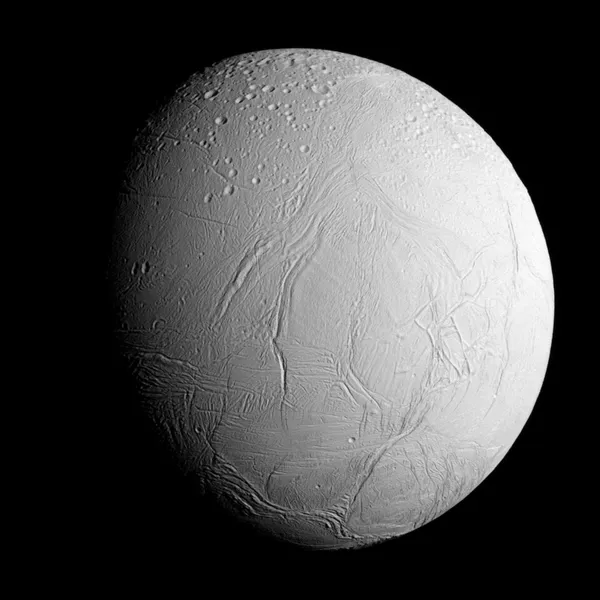
Enceladus is the sixth-largest moon of Saturn and the 18th largest in the Solar System. It is about 500 kilometres (310 miles) in diameter, about a tenth of that of Saturn's largest moon, Titan. It is covered by clean, freshly deposited snow hundreds of meters thick, making it one of the most reflective bodies of the Solar System. Consequently, its surface temperature at noon reaches only −198 °C (75.1 K; −324.4 °F), far colder than a light-absorbing body would be. Despite its small size, Enceladus has a wide variety of surface features, ranging from old, heavily cratered regions to young, tectonically deformed terrain. Enceladus was discovered on August 28, 1789, by William Herschel, but little was known about it until the two Voyager spacecraft, Voyager 1 and Voyager 2, flew by Saturn in 1980 and 1981. In 2005, the spacecraft Cassini started multiple close flybys of Enceladus, revealing its surface and environment in greater detail. In particular, Cassini discovered water-rich plumes venting from the south polar region. Cryovolcanoes near the south pole shoot geyser-like jets of water vapour, molecular hydrogen, other volatiles, and solid material, including sodium chloride crystals and ice particles, into space, totalling about 200 kilograms (440 pounds) per second. More than 100 geysers have been identified. Some of the water vapour falls back as snow, now several hundred metres thick; the rest escapes and supplies most of the material making up Saturn's E ring. According to NASA scientists, the plumes are similar in composition to comets. In 2014, NASA reported that Cassini had found evidence for a large south polar subsurface ocean of liquid water with a thickness of around 10 km (6 mi). The existence of Enceladus's subsurface ocean has since been mathematically modelled and replicated. These observations of active cryoeruptions, along with the finding of escaping internal heat and very few (if any) impact craters in the south polar region, show that Enceladus is currently geologically active. Like many other satellites in the extensive systems of the giant planets, Enceladus participates in an orbital resonance.
Also on this shelf
Future of Earth.
FR-1 (satellite).
See also
Uncatalogued shelfText from Wikipedia; plate via Wikimedia Commons. Text CC BY-SA 4.0; plate freely licensed (see Commons). Source record. Images and catalogue data are reproduced from open-access collections.