Astronomy and Space
H-II Transfer Vehicle
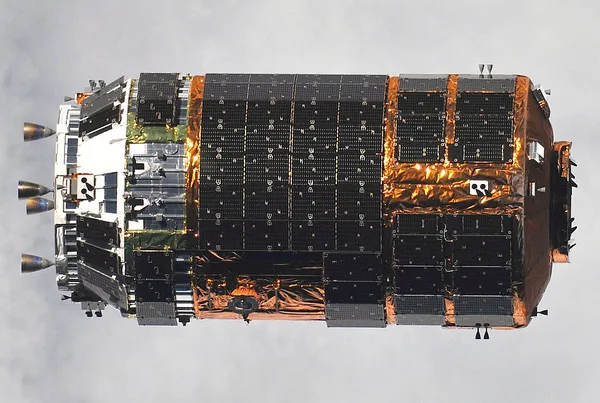
The H-II Transfer Vehicle (HTV), also called Kounotori (Japanese: こうのとり; lit. 'white stork'), was an expendable Japanese automated cargo spacecraft designed for International Space Station (ISS) resupply missions, particularly Kibō, the Japanese laboratory module. Development of the spacecraft began in the early 1990s and the HTV's first mission, HTV-1, was launched on 10 September 2009 on an H-IIB launch vehicle. The HTV was crucial for ISS resupply, especially after the retirement of the Space Shuttle, as it was the only vehicle capable of transporting large International Standard Payload Racks (ISPR) and disposing of old ones within the ISS's US Orbital Segment. The final HTV mission, Kounotori 9, was launched on 20 May 2020. HTV's successor, the HTV-X, made its maiden flight in October 2025.
Also on this shelf
History of spaceflight.
Autonomous underwater vehicle.
See also
Uncatalogued shelfText from Wikipedia; plate via Wikimedia Commons. Text CC BY-SA 4.0; plate freely licensed (see Commons). Source record. Images and catalogue data are reproduced from open-access collections.