Astronomy and Space
Launch pad
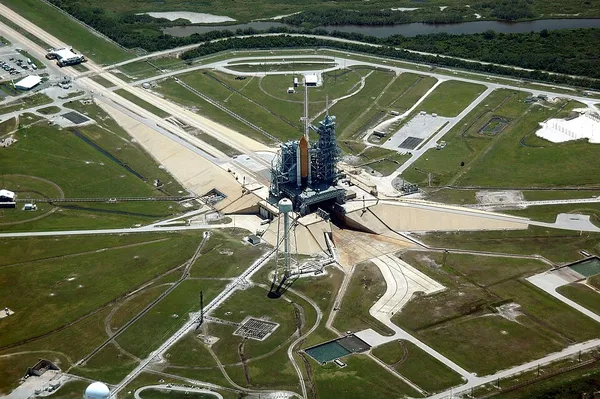
A launch pad is an above-ground facility from which a rocket-powered missile or space vehicle is vertically launched. The term launch pad can be used to describe just the central launch platform (mobile launcher platform), or the entire complex (launch complex). The entire complex will include a launch mount or launch platform to physically support the vehicle, a service structure with umbilicals, and the infrastructure required to provide propellants, cryogenic fluids, electrical power, communications, telemetry, rocket assembly, payload processing, storage facilities for propellants and gases, equipment, access roads, and drainage. Most launch pads include fixed service structures to provide one or more access platforms to assemble, inspect, and maintain the vehicle and to allow access to the spacecraft, including the loading of crew. The pad may contain a flame deflection structure to prevent the intense heat of the rocket exhaust from damaging the vehicle or pad structures, and a sound suppression system spraying large quantities of water may be employed. The pad may also be protected by lightning arresters. A spaceport typically includes multiple launch complexes and other supporting infrastructure. A launch pad is distinct from a missile launch facility (or missile silo or missile complex), which also launches a missile vertically but is located underground in order to help harden it against enemy attack. The launch complex for liquid fueled rockets often has extensive ground support equipment including propellant tanks and plumbing to fill the rocket before launch. Cryogenic propellants (liquid oxygen oxidizer, and liquid hydrogen or liquid methane fuel) need to be continuously topped off (i.e., boil-off replaced) during the launch sequence (countdown), as the vehicle awaits liftoff. This becomes particularly important as complex sequences may be interrupted by planned or unplanned holds to fix problems. Most rockets need to be supported and held down for a few seconds after ignition while the engines build up to full thrust. The vehicle is commonly held on the pad by hold-down arms or explosive bolts, which are triggered when the vehicle is stable and ready to fly, at which point all umbilical connections with the pad are released.
Also on this shelf
High Resolution Coronal Imager.
Gamma Ceti.
See also
Uncatalogued shelfText from Wikipedia; plate via Wikimedia Commons. Text CC BY-SA 4.0; plate freely licensed (see Commons). Source record. Images and catalogue data are reproduced from open-access collections.