Astronomy and Space
21 Aquilae
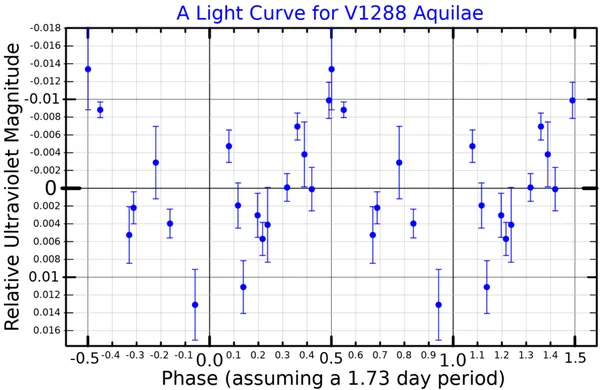
21 Aquilae is a solitary variable star in the equatorial constellation of Aquila. It has the variable star designation V1288 Aql; 21 Aquilae is its Flamsteed designation. This object is visible to the naked eye as a dim, blue-white hued star with a baseline apparent visual magnitude of about 5.1. The star is located at a distance of around 680 light-years (210 parsecs) from Earth, give or take a 20 light-year margin of error. It is moving closer to the Earth with a heliocentric radial velocity of –5 km/s. In 1962, Helmut A. Abt and John C. Gloson published data showing that 21 Aquilae was a variable star. Based on that publication, the star was given its variable star designation in 1972. The stellar classification of this star is B8 II-III, with the luminosity class of II-III suggesting that the spectrum displays elements of both a giant star and a bright giant. It is a chemically peculiar star of the Mercury-Manganese type (CP3), although some catalogues consider that status to be doubtful. This is a probable Alpha2 Canum Venaticorum variable that ranges in visual magnitude from 5.06 down to 5.16. The star is radiating 704 times the luminosity of the Sun from its photosphere at an effective temperature of 12,014 K; this gives it the blue-white glow of a B-type star. 21 Aquilae is catalogued as an optical double star, having a 12th magnitude companion 37″ away as of 2010. It was first identified as a double star by John Herschel. The companion is a distant background object.
Also on this shelf
History of the Deep Space Network.
B Persei.
See also
Uncatalogued shelfText from Wikipedia; plate via Wikimedia Commons. Text CC BY-SA 4.0; plate freely licensed (see Commons). Source record. Images and catalogue data are reproduced from open-access collections.