Astronomy and Space
Aldebaran
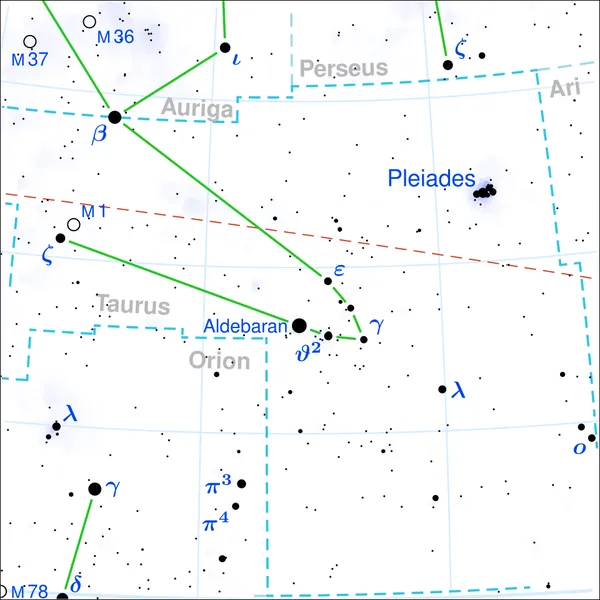
Aldebaran (Arabic: الدَّبَرَان, lit. 'The Follower') is a red giant star in the zodiac constellation of Taurus. It has the Bayer designation α Tauri, which is Latinized to Alpha Tauri and abbreviated Alpha Tau or α Tau. Aldebaran varies in brightness from an apparent visual magnitude of 0.75 down to 0.95, making it the brightest star in the constellation, as well as (typically) the fourteenth-brightest star in the night sky. It is at a distance of approximately 67 light-years. The star lies along the line of sight to the nearby Hyades cluster, but is unrelated and much older than the young cluster. Aldebaran is a red giant with a radius about 45 times that of the Sun's, though its mass is about equal. This is because, with an age of over six billion years, the star is in the final stages of its life, having evolved off the main sequence on the Hertzsprung–Russell diagram after depleting the supply of hydrogen in its core. The star is cooler than the Sun with a surface temperature of 3,900 K, though is over 400 times as luminous due to its surface area. The star spins slowly, taking 520 days to complete a rotation. Together with the star Alpha Tauri B (Aldebaran B), it makes a binary star system with an orbital separation of at least 680 astronomical units, or 680 times the average distance from Earth to the Sun. The companion is significantly fainter in the sky, having an apparent magnitude of 13.21, and cannot be seen with the naked eye.
Also on this shelf
History of Solar System formation and evolution hypotheses.
Babylonian star catalogues.
See also
Uncatalogued shelfText from Wikipedia; plate via Wikimedia Commons. Text CC BY-SA 4.0; plate freely licensed (see Commons). Source record. Images and catalogue data are reproduced from open-access collections.