Astronomy and Space
Exploration of Io
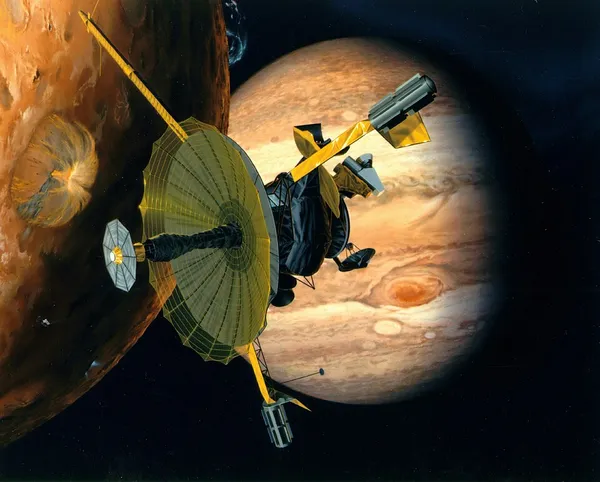
The exploration of Io, Jupiter's innermost Galilean and third-largest moon, began with its discovery in 1610 and continues today with Earth-based observations and visits by spacecraft to the Jupiter system. Italian astronomer Galileo Galilei was the first to record an observation of Io on January 8, 1610, though Simon Marius may have also observed Io at around the same time. During the 17th century, observations of Io and the other Galilean satellites helped with the measurement of longitude by map makers and surveyors, with validation of Kepler's Third Law of planetary motion, and with measurement of the speed of light. Based on ephemerides produced by astronomer Giovanni Cassini and others, Pierre-Simon Laplace created a mathematical theory to explain the resonant orbits of three of Jupiter's moons, Io, Europa, and Ganymede. This resonance was later found to have a profound effect on the geologies of these moons. Improved telescope technology in the late 19th and 20th centuries allowed astronomers to resolve large-scale surface features on Io as well as to estimate its diameter and mass. The advent of uncrewed spaceflight in the 1950s and 1960s provided an opportunity to observe Io up-close. In the 1960s the moon's effect on Jupiter's magnetic field was discovered. The flybys of the two Pioneer probes, Pioneer 10 and 11 in 1973 and 1974, provided the first accurate measurement of Io's mass and size. Data from the Pioneers also revealed an intense belt of radiation near Io and suggested the presence of an atmosphere. In 1979, the two Voyager spacecraft flew through the Jupiter system. Voyager 1, during its encounter in March 1979, observed active volcanism on Io for the first time and mapped its surface in great detail, particularly the side that faces Jupiter. The Voyagers observed the Io plasma torus and Io's sulfur dioxide (SO2) atmosphere for the first time. NASA launched the Galileo spacecraft in 1989, which entered Jupiter's orbit in December 1995. Galileo allowed detailed study of both the planet and its satellites, including six flybys of Io between late 1999 and early 2002 that provided high-resolution images and spectra of Io's surface, confirming the presence of high-temperature silicate volcanism on Io.
Also on this shelf
Extraterrestrial sky.
26 Andromedae.
See also
Uncatalogued shelfText from Wikipedia; plate via Wikimedia Commons. Text CC BY-SA 4.0; plate freely licensed (see Commons). Source record. Images and catalogue data are reproduced from open-access collections.