Astronomy and Space
Climate of Mars
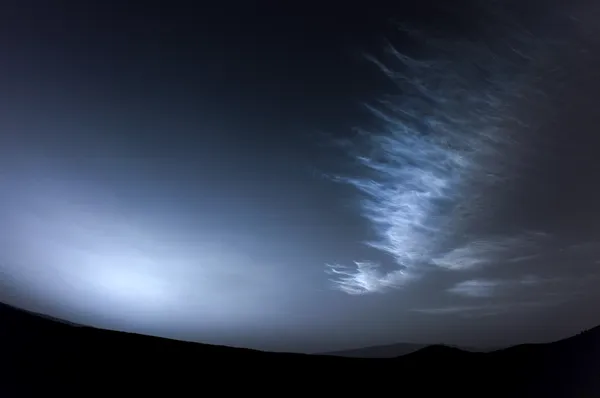
The climate of Mars has been a topic of scientific curiosity for centuries, in part because it is the only terrestrial planet whose surface can be easily observed in detail from Earth using a telescope. Although Mars is smaller than Earth, with only one-tenth of Earth's mass, and is 50% farther from the Sun than Earth, its climate has important similarities with Earth's, such as the presence of polar ice caps, seasonal changes, and observable weather patterns. It has attracted sustained study from planetologists and climatologists. While Mars' climate has similarities to Earth's, including periodic ice ages, there are also important differences, such as much lower thermal inertia. Mars' atmosphere has a scale height of approximately 11 km (36,000 ft), which is 60% greater than that of Earth. The climate is of considerable relevance to the question of whether life is or ever has been present on the planet. Mars has been studied with Earth-based instruments since the 17th century, but it is only since the exploration of Mars began in the mid-1960s that close-range observation has been possible. Flyby and orbital spacecraft have provided data from above, while landers and rovers have measured atmospheric conditions directly. Advanced Earth-orbital instruments today continue to provide some useful "big picture" observations of relatively large weather phenomena. The first Martian flyby mission was Mariner 4, which arrived in 1965. That quick two-day pass (July 14–15, 1965) with crude instruments contributed little to the state of knowledge of Martian climate. Later Mariner missions (Mariner 6 and 7) filled in some of the gaps in basic climate information. Data-based climate studies started in earnest with the Viking program landers in 1975 and continue with such probes as the Mars Reconnaissance Orbiter. This observational work has been complemented by a type of scientific computer simulation called the Mars general circulation model (MGCM). Several different iterations of MGCM have led to an increased understanding of Mars as well as the limits of such models.
Also on this shelf
Laser propulsion.
Beta2 Sagittarii.
See also
Uncatalogued shelfText from Wikipedia; plate via Wikimedia Commons. Text CC BY-SA 4.0; plate freely licensed (see Commons). Source record. Images and catalogue data are reproduced from open-access collections.