Astronomy and Space
Barnard's Star
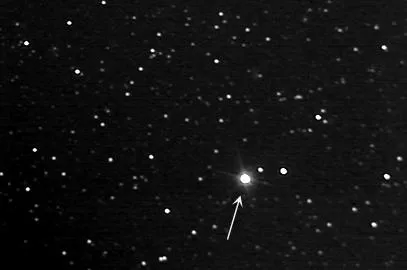
Barnard's Star is a small red dwarf star in the constellation of Ophiuchus. At a distance of 5.96 light-years (1.83 pc) from Earth, it is the fourth-nearest-known individual star to the Sun after the three components of the Alpha Centauri system, and is the closest star in the northern celestial hemisphere. Its stellar mass is about 16% of the Sun's, and it has 19% of the Sun's diameter. Despite its proximity, the star has a dim apparent visual magnitude of +9.5 and is invisible to the unaided eye; it is much brighter in the infrared than in visible light. Barnard's Star is among the most studied red dwarfs because of its proximity and favorable location for observation near the celestial equator. Historically, research on Barnard's Star has focused on measuring its stellar characteristics, its astrometry, and also refining the limits of possible extrasolar planets. Although Barnard's Star is ancient, it still experiences stellar flare events, one being observed in 1998. Barnard's Star hosts a system of four close-orbiting, sub-Earth-mass planets (Barnard's Star b, c, d & e). Multiple claims for a planetary system had been proposed since the beginning of the twentieth century, notably by Peter van de Kamp in the 1960s, but none were supported by follow-up studies, until the now known four-planet system was discovered by two independent teams of astronomers in 2024–2025.
Also on this shelf
Anubis (crater).
Ion thruster.
See also
Uncatalogued shelfText from Wikipedia; plate via Wikimedia Commons. Text CC BY-SA 4.0; plate freely licensed (see Commons). Source record. Images and catalogue data are reproduced from open-access collections.