Astronomy and Space
Delta Indi
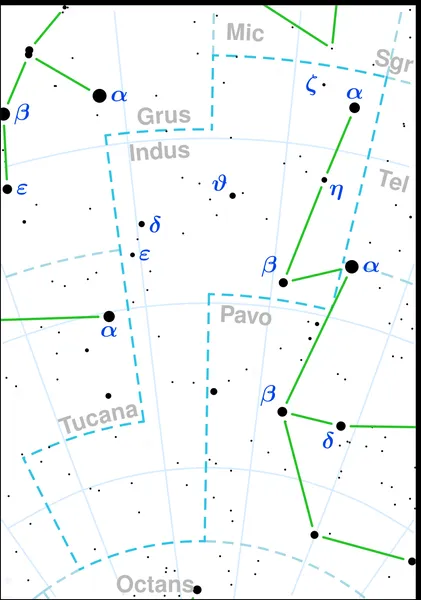
Delta Indi, Latinized from δ Indi, is a binary star system in the southern constellation of Indus. It is visible to the naked eye with a combined apparent visual magnitude of +4.40. The brighter primary, designated component A, is magnitude 4.80 while the companion, component B, is magnitude 5.96. Based upon an annual parallax shift of 17.34 mas as measured from Earth, the system is located about 188 light years from the Sun. The binary nature of this system was discovered by South African astronomer William Stephen Finsen from 1936 onward, with his published orbital elements appearing in 1956. The pair have an orbital period of 12.16 years, a semimajor axis of 0.173 arc seconds, and an eccentricity of around 0.005. They have been listed with a stellar classification of F0 IV by multiple authors, suggesting they are yellow-white hued F-type subgiant stars. However, their estimated masses do not match this classification, so Docobo and Andrade (2013) suggest the Hipparcos parallax may have been underestimated. One paper has published separate spectral classes of A8(V) and F3(V) respectively for the two components. A more recent publication suggests spectral types of A5IV + F0IV.
Also on this shelf
2 Ceti.
38 Lyncis.
See also
Uncatalogued shelfText from Wikipedia; plate via Wikimedia Commons. Text CC BY-SA 4.0; plate freely licensed (see Commons). Source record. Images and catalogue data are reproduced from open-access collections.