Astronomy and Space
Lambda-CDM model
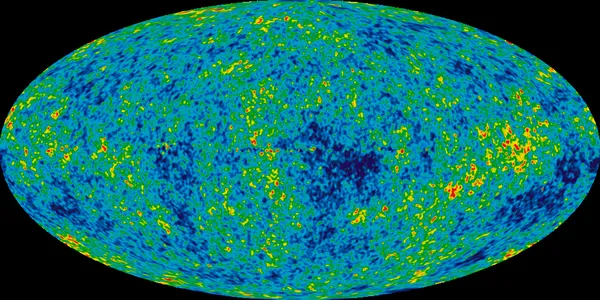
The Lambda-CDM, Lambda cold dark matter, or ΛCDM model is the standard form of the Big Bang theory of cosmology governing the chronology of the universe. As implied by its name, the model postulates a cosmological constant, denoted by lambda (Λ), associated with dark energy, cold dark matter, denoted by CDM as well as ordinary matter. It is the simplest model that provides a reasonably good account of: the existence and structure of the cosmic microwave background; the large-scale structure in the distribution of galaxies; the observed abundances of hydrogen (including deuterium), helium, and lithium; the accelerating expansion of the universe observed in the light from distant galaxies and supernovae. The model assumes that general relativity is the correct theory of gravity on cosmological scales. It emerged in the late 1990s as a concordance cosmology, after a period when disparate observed properties of the universe appeared mutually inconsistent, and there was no consensus on the makeup of the energy density of the universe. The ΛCDM model has been successful in modeling a broad collection of astronomical observations over decades. Remaining issues challenge the assumptions of the ΛCDM model and have led to many alternative models.
Also on this shelf
2013 in science.
Delta Leonis.
See also
Uncatalogued shelfText from Wikipedia; plate via Wikimedia Commons. Text CC BY-SA 4.0; plate freely licensed (see Commons). Source record. Images and catalogue data are reproduced from open-access collections.