Astronomy and Space
Io (moon)
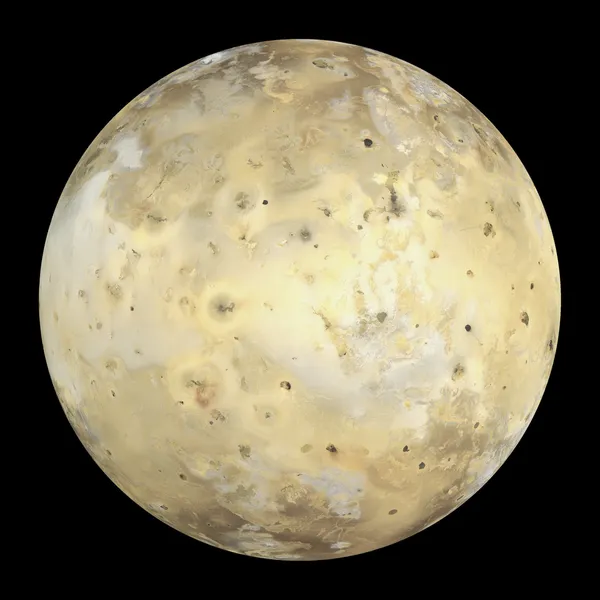
Io () is the innermost and second smallest of the four Galilean moons of Jupiter. Slightly larger than Earth's Moon, Io is the fourth-largest natural satellite in the Solar System, has the highest density and strongest surface gravity of any natural satellite, and the lowest amount of water by atomic ratio of any known astronomical object in the Solar System. With over 400 active volcanoes, Io is the most geologically active object in the Solar System. This extreme geologic activity results from tidal heating from friction generated within Io's interior as it is pulled between Jupiter and two other Galilean moons—Europa and Ganymede. Several volcanoes produce plumes of sulfur and sulfur dioxide as high as 500 km (300 mi) above the surface. Io's surface is also dotted with more than 100 mountains uplifted by extensive compression at the base of Io's silicate crust. Some of these peaks are taller than Mount Everest, the highest point on Earth's surface. Unlike most moons in the outer Solar System, which are mostly composed of water ice, Io is primarily composed of silicate rock surrounding a molten iron or iron sulfide core. Most of Io's surface is composed of extensive plains with a frosty coating of sulfur and sulfur dioxide. Io's volcanism is responsible for many of its unique features. Its volcanic plumes and lava flows produce large surface changes and paint the surface in various subtle shades of yellow, red, white, black, and green, largely due to allotropes and compounds of sulfur. Numerous extensive lava flows, several more than 500 km (300 mi) in length, also mark the surface. The materials produced by this volcanism make up Io's thin, patchy atmosphere, and they also greatly affect the nature and radiation levels of Jupiter's extensive magnetosphere. Io's volcanic ejecta also produces a large, intense plasma torus around Jupiter, creating a hostile radiation environment on and around the moon. It was discovered along with the other Galilean moons in 1610 by Galileo Galilei and named after the mythological character Io, a priestess of Hera who became one of Zeus's lovers. The discovery of the Galilean moons played a significant role in the development of astronomy, furthering the adoption of the Copernican model of the Solar System and the development of Kepler's laws of planetary motion.
Also on this shelf
2011 in spaceflight.
58 Eridani.
See also
Uncatalogued shelfText from Wikipedia; plate via Wikimedia Commons. Text CC BY-SA 4.0; plate freely licensed (see Commons). Source record. Images and catalogue data are reproduced from open-access collections.