Astronomy and Space
Apollo 14
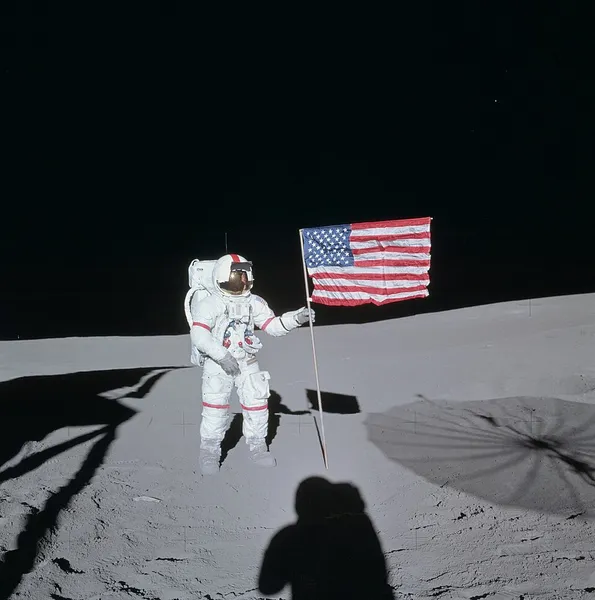
Apollo 14 (January 31 – February 9, 1971) was the eighth crewed mission in the United States Apollo program operated by NASA, the third to land on the Moon, and the first to land in the lunar highlands. It was the last of the "H missions", landings at specific sites of scientific interest on the Moon for two-day stays with two lunar extravehicular activities (EVAs or moonwalks). The mission was originally scheduled for 1970, but was postponed because of the investigation following the failure of Apollo 13 to reach the Moon's surface, and the need for modifications to the spacecraft as a result. Commander Alan Shepard, Command Module Pilot Stuart Roosa, and Lunar Module Pilot Edgar Mitchell launched on their nine-day mission on Sunday, January 31, 1971, at 4:03:02 p.m. EST. En route to the lunar landing, the crew overcame malfunctions that might have resulted in a second consecutive aborted mission, and possibly, the premature end of the Apollo program. Shepard and Mitchell made their lunar landing on February 5 in the Fra Mauro formation – originally the target of Apollo 13. During the two walks on the surface, they collected 94.35 pounds (42.80 kg) of Moon rocks and deployed several scientific experiments. To the dismay of some geologists, Shepard and Mitchell did not reach the rim of Cone crater as had been planned, though they came close. In Apollo 14's most famous event, Shepard hit two golf balls he had brought with him with a makeshift club. While Shepard and Mitchell were on the surface, Roosa remained in lunar orbit aboard the Command and Service Module, performing scientific experiments and photographing the Moon, including the landing site of the future Apollo 16 mission. He took several hundred seeds on the mission, many of which were germinated on return, resulting in the so-called Moon trees, that were widely distributed in the following years. After liftoff from the lunar surface and a successful docking, the spacecraft was flown back to Earth where the three astronauts splashed down safely in the Pacific Ocean on February 9.
Also on this shelf
Chi1 Orionis.
3 Camelopardalis.
See also
Uncatalogued shelfText from Wikipedia; plate via Wikimedia Commons. Text CC BY-SA 4.0; plate freely licensed (see Commons). Source record. Images and catalogue data are reproduced from open-access collections.