Astronomy and Space
Cosmic ray
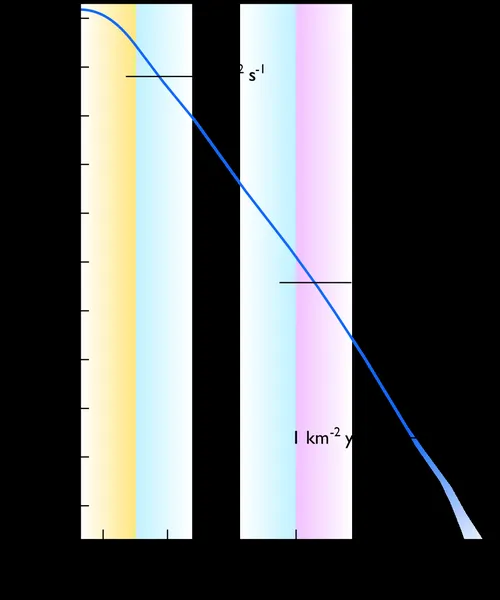
Cosmic rays or astroparticles are high-energy particles or clusters of particles (primarily represented by protons or atomic nuclei) that move through space at nearly the speed of light. They originate from outside the Solar System—from the Milky Way, from distant galaxies, and from the Sun. Upon impact with Earth's atmosphere, cosmic rays produce showers of secondary particles, some of which reach the surface, although the bulk are deflected into space by Earth's magnetic field (the magnetosphere) or by the heliosphere. Cosmic rays were discovered by Victor Hess in 1912 in balloon experiments, for which he was awarded the 1936 Nobel Prize in Physics. Direct measurement of cosmic rays, especially at lower energies, has been possible since the first satellites in the late 1950s. Particle detectors similar to those used in nuclear and high-energy physics are used on satellites and space probes for research into cosmic rays. Data from the Fermi Space Telescope (2013) have been interpreted as evidence that a significant fraction of primary cosmic rays originate from the supernova explosions of stars. Based on observations of neutrinos and gamma rays from blazar TXS 0506+056 in 2018, active galactic nuclei also appear to produce cosmic rays.
Also on this shelf
31 Crateris.
CX Draconis.
See also
Uncatalogued shelfText from Wikipedia; plate via Wikimedia Commons. Text CC BY-SA 4.0; plate freely licensed (see Commons). Source record. Images and catalogue data are reproduced from open-access collections.