Astronomy and Space
EPOXI
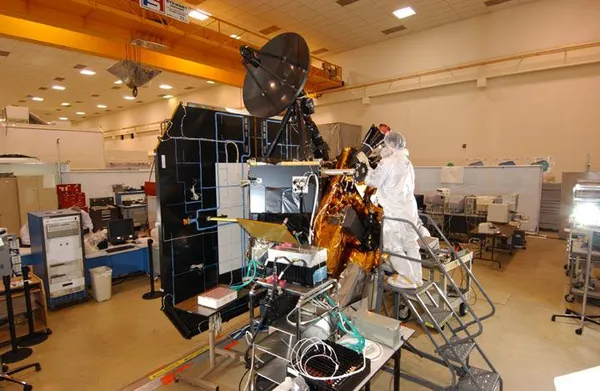
EPOXI was a compilation of NASA Discovery program missions led by the University of Maryland and principal investigator Michael A'Hearn, with co-operation from the Jet Propulsion Laboratory and Ball Aerospace. EPOXI uses the Deep Impact spacecraft in a campaign consisting of two missions: the Deep Impact Extended Investigation (DIXI) and Extrasolar Planet Observation and Characterization (EPOCh). DIXI aimed to send the Deep Impact spacecraft on a flyby of another comet, after its primary mission was completed in July 2005, while EPOCh saw the spacecraft's photographic instruments as a space observatory, studying extrasolar planets. DIXI successfully sent the Deep Impact spacecraft on a flyby of comet Hartley 2 on November 4, 2010, revealing a "hyperactive, small and feisty" comet, after three gravity assists from Earth in December 2007, December 2008 and June 2010. The DIXI mission was not without problems, however; the spacecraft had initially been targeted for a December 5, 2008 flyby of comet Boethin, though, the comet could not be located, and was later declared a lost comet, prompting mission planners to reorganize a flyby of an alternative target, Hartley 2. After its flyby of Hartley 2, the spacecraft was also set to make a close flyby of the Apollo asteroid (163249) 2002 GT in 2020. The mission ended after contact with the spacecraft was suddenly lost in August 2013 and attempts to re-establish contact in the following month had failed. Mission scientists theorized that a Y2K-like problem had plagued the spacecraft's software.
Also on this shelf
Gliese 777.
Epsilon Indi.
See also
Uncatalogued shelfText from Wikipedia; plate via Wikimedia Commons. Text CC BY-SA 4.0; plate freely licensed (see Commons). Source record. Images and catalogue data are reproduced from open-access collections.