Astronomy and Space
486958 Arrokoth
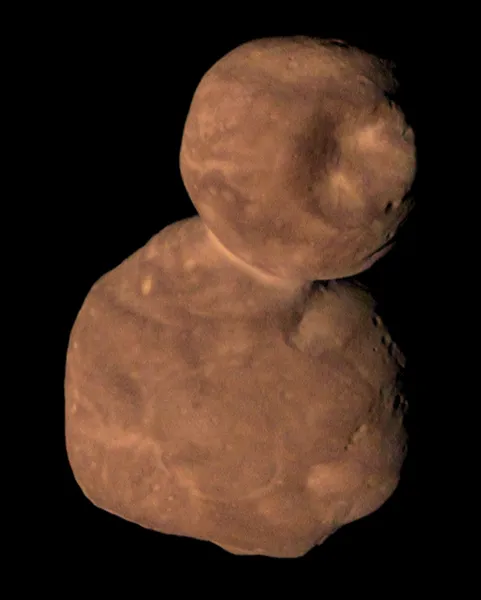
486958 Arrokoth (provisional designation 2014 MU69; formerly nicknamed Ultima Thule) is a small, icy Kuiper belt object orbiting the Sun beyond Neptune and Pluto. It became the farthest object in the Solar System visited by a spacecraft when the NASA space probe New Horizons flew past it on 1 January 2019. Arrokoth was discovered on 26 June 2014 by astronomer Marc Buie and the New Horizons Search Team, who had been using the Hubble Space Telescope to find Kuiper belt objects that New Horizons could visit. Arrokoth is a contact binary—a "snowman"-shaped object composed of two lobes connected by a narrow neck of material. The lobes of Arrokoth, named Wenu and Weeyo, are believed to be former planetesimals that once formed a binary system, but gently merged together. Wenu and Weeyo have flattened shapes consisting of distinct mounds, which indicate that they formed from a collection of smaller planetesimals 4.5 billion years ago. The surface of Arrokoth is tinted red by tholins and shows little cratering, which suggests that it has undergone little change since its formation. The primitive nature of Arrokoth is supported by its nearly circular and low-inclination orbit around the Sun, which suggests that it has never been disturbed by the gravitational influence of the planets.
Also on this shelf
Apollo 12.
Epsilon Aurigae.
See also
Uncatalogued shelfText from Wikipedia; plate via Wikimedia Commons. Text CC BY-SA 4.0; plate freely licensed (see Commons). Source record. Images and catalogue data are reproduced from open-access collections.