Astronomy and Space
Atmosphere of Mars
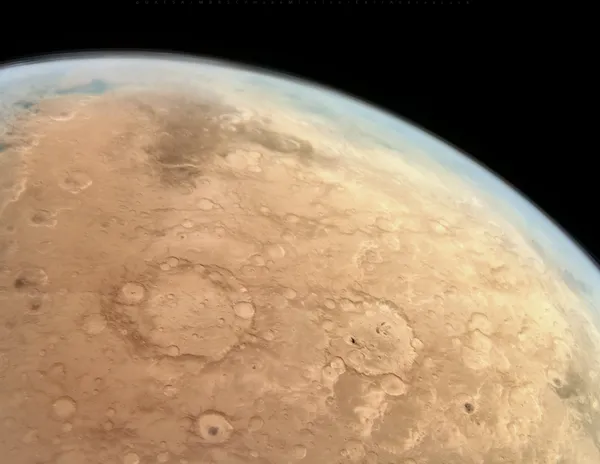
The atmosphere of Mars is primarily composed of carbon dioxide (95%), molecular nitrogen (2.85%), and argon (2%). It also contains trace levels of water vapor, oxygen, carbon monoxide, hydrogen, and noble gases. The atmosphere of Mars is much thinner and colder than Earth's having a max density 20 g/m3 (about 2% of Earth's value) with a temperature generally below zero down to −60 °C. The average surface pressure is about 610 pascals (0.088 psi) which is 0.6% of the Earth's value. The currently thin Martian atmosphere prohibits the existence of liquid water on the surface of Mars, but many studies suggest that the Martian atmosphere was much thicker in the past. The higher density during spring and fall is reduced by 25% during the winter when carbon dioxide partly freezes at the pole caps. The highest atmospheric density on Mars is equal to the density found 35 km (22 mi) above the Earth's surface and is ≈0.020 kg/m3. The atmosphere of Mars has been losing mass to space since the planet's core slowed down, and the leakage of gases still continues today. The atmosphere of Mars is colder than Earth's owing to the larger distance from the Sun, receiving less solar energy and has a lower effective temperature, which is about 210 K (−63 °C; −82 °F). The average surface emission temperature of Mars is just 215 K (−58 °C; −73 °F), which is comparable to inland Antarctica. Although Mars's atmosphere consists primarily of carbon dioxide, the greenhouse effect in the Martian atmosphere is much weaker than Earth's: 5 °C (9.0 °F) on Mars, versus 33 °C (59 °F) on Earth due to the much lower density of carbon dioxide, leading to less greenhouse warming. Furthermore, the Martian atmosphere contains much less water vapor than Earth's atmosphere and water vapor is another important contributor to the greenhouse effect. The daily range of temperature in the lower atmosphere presents ample variation due to the low thermal inertia; it can range from −75 °C (−103 °F) to near 0 °C (32 °F) near the surface in some regions.
Also on this shelf
31 Pegasi.
Integrated Science Investigation of the Sun.
See also
Uncatalogued shelfText from Wikipedia; plate via Wikimedia Commons. Text CC BY-SA 4.0; plate freely licensed (see Commons). Source record. Images and catalogue data are reproduced from open-access collections.