Astronomy and Space
3I/ATLAS
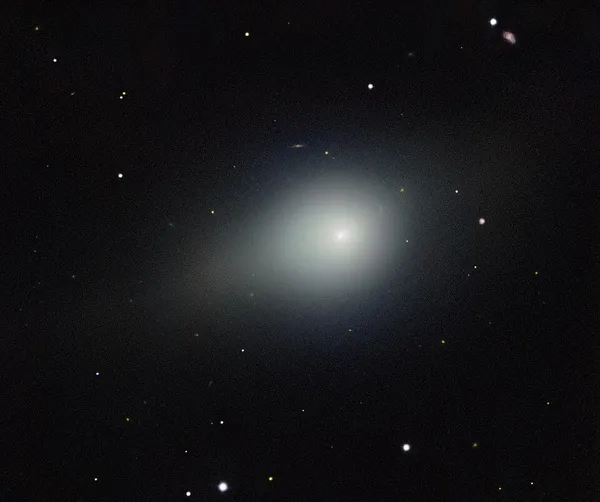
3I/ATLAS, also known as C/2025 N1 (ATLAS) and previously as A11pl3Z, is an interstellar comet discovered on 1 July 2025 by the Asteroid Terrestrial-impact Last Alert System (ATLAS) station. The comet follows an unbound, hyperbolic trajectory past the Sun, and passed by Earth at 1.8 AU, posing no threat. The prefix "3I" designates it as the third confirmed interstellar object passing through the Solar System, after 1I/ʻOumuamua and 2I/Borisov. 3I/ATLAS is an active comet consisting of a solid icy nucleus and a coma, which is a cloud of gas and icy dust escaping from the nucleus. The Sun is responsible for the comet's activity because it heats up the comet's nucleus to sublimate its ice into gas, which outgasses and lifts up dust from the comet's surface to form its coma. Images taken by the Hubble Space Telescope and various interplanetary spacecraft suggest that the diameter of 3I/ATLAS's nucleus is less than 1 km (0.62 mi). Observations by the James Webb Space Telescope (JWST) have shown that 3I/ATLAS is unusually rich in carbon dioxide, and contains a small amount of water ice, water vapor, carbon monoxide, carbonyl sulfide, and methane. Observations by the Very Large Telescope have also shown that 3I/ATLAS is emitting cyanide gas and atomic nickel vapor, at concentrations similar to those seen in Solar System comets. The comet came to solar conjunction on 21 October 2025, and it came closest to the Sun on 29 October 2025, at a distance of 1.36 AU (203 million km; 126 million mi) from the Sun, which is between the orbits of Earth and Mars. The comet appears to have originated from either the Milky Way's thin disk, or thick disk; if 3I/ATLAS originated from the thick disk, the comet could be at least 7 billion years old—older than the Solar System.
Also on this shelf
Alpha Herculis.
Life-support system.
See also
Uncatalogued shelfText from Wikipedia; plate via Wikimedia Commons. Text CC BY-SA 4.0; plate freely licensed (see Commons). Source record. Images and catalogue data are reproduced from open-access collections.