Astronomy and Space
Mars Reconnaissance Orbiter
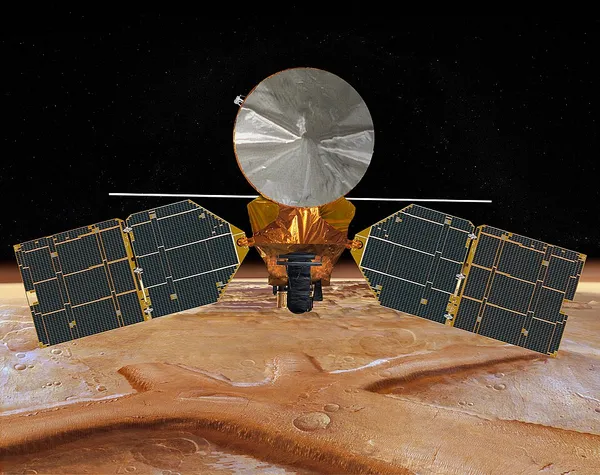
The Mars Reconnaissance Orbiter (MRO) is a spacecraft designed to search for the existence of water on Mars and provide support for missions to Mars, as part of NASA's Mars Exploration Program. It was launched from Cape Canaveral on August 12, 2005, at 11:43 UTC and reached Mars on March 10, 2006, at 21:24 UTC. In November 2006, after six months of aerobraking, it entered its final science orbit and began its primary science phase. Mission objectives include observing the climate of Mars, investigating geologic forces, providing reconnaissance of future landing sites, and relaying data from surface missions back to Earth. To support these objectives, the MRO carries different scientific instruments, including three cameras, two spectrometers and a subsurface radar. As of July 29, 2023, the MRO has returned over 450 terabits of data, helped choose safe landing sites for NASA's Mars landers, and discovered pure water ice in new craters and further evidence that water once flowed on the surface on Mars. The spacecraft continues to operate at Mars, far beyond its intended design life. Due to its critical role as a high-speed data-relay for ground missions, NASA intends to continue the mission as long as possible, at least through the late 2020s. As of October 5, 2026, the MRO has been active at Mars for 7313 sols, or 20 years, 6 months and 25 days, and is the third longest-lived spacecraft to orbit Mars, after 2001 Mars Odyssey and Mars Express.
Also on this shelf
162173 Ryugu.
Comet Hopper.
See also
Uncatalogued shelfText from Wikipedia; plate via Wikimedia Commons. Text CC BY-SA 4.0; plate freely licensed (see Commons). Source record. Images and catalogue data are reproduced from open-access collections.