Astronomy and Space
Airborne observatory
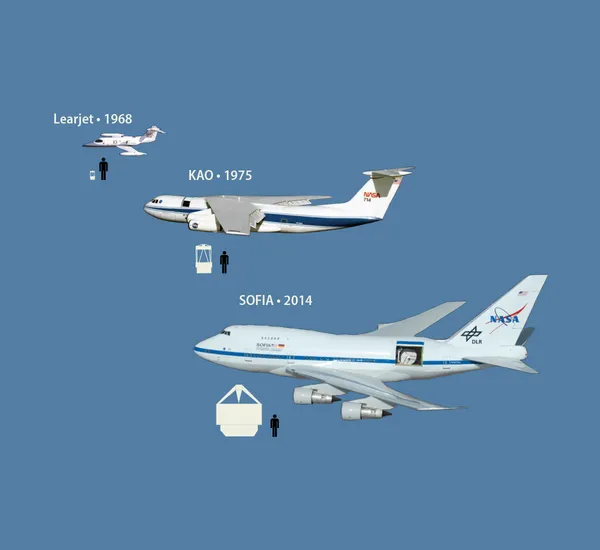
An airborne observatory is an airplane or airship with an astronomical telescope. By carrying the telescope to a sufficiently high altitude, the telescope can avoid cloud cover, pollution, and carry out observations in the infrared spectrum, above water vapor in the atmosphere which absorbs infrared radiation. Some drawbacks to this approach are the instability of the lifting platform, the weight restrictions on the instrument, the need to safely recover the gear afterward, and the cost compared to a comparable ground-based observatory. Multiple observations of solar eclipses were performed from 1920 to 1980. NASA created first specialised airborne observatory, Galileo, in 1965. SOFIA, the latest such observatory, was retired in 2022.
Also on this shelf
Achernar.
Camelopardalis.
See also
Uncatalogued shelfText from Wikipedia; plate via Wikimedia Commons. Text CC BY-SA 4.0; plate freely licensed (see Commons). Source record. Images and catalogue data are reproduced from open-access collections.