Astronomy and Space
Galaxy rotation curve
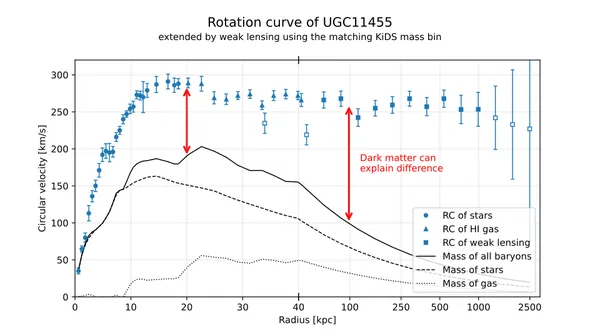
The rotation curve of a disc galaxy (also called a velocity curve) is a plot of the orbital speeds of visible stars or gas in that galaxy versus their radial distance from that galaxy's centre. It is typically rendered graphically as a plot, and the data observed from each side of a spiral galaxy are generally asymmetric, so that data from each side are averaged to create the curve. The experimental curves observed are at significant variance with gravitational theory applied to the matter observed in a galaxy. Theories involving unobservable dark matter are the main postulated explanation of this discrepancy. Considering their mass distributions, the rotational/orbital speeds of galaxies/stars would not be expected to follow rules such as Kepler's third law applying to smaller orbital systems such as stars/planets and planets/moons with most mass at the centre. Stars revolve around their galaxy's centre at equal or increasing speed over a large range of distances. Even considering this, however, the mass estimations for galaxies based on the light they emit are far too low to explain the velocity observations. Though dark matter is by far the most accepted explanation of the rotation problem, other theories have been proposed. One of the most notable is modified Newtonian dynamics (MOND), which involves alternative laws of gravitation.
Also on this shelf
Autonomous Landing Hazard Avoidance Technology.
Cape Canaveral Space Launch Complex 37.
See also
Uncatalogued shelfText from Wikipedia; plate via Wikimedia Commons. Text CC BY-SA 4.0; plate freely licensed (see Commons). Source record. Images and catalogue data are reproduced from open-access collections.