Astronomy and Space
Jupiter's South Pole
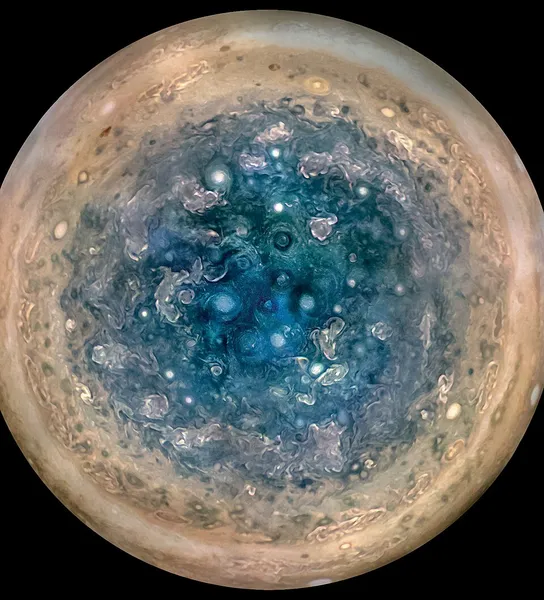
The South Pole of Jupiter was first photographed in detail by the Juno spacecraft, which arrived at Jupiter in July 2016 and entered a polar orbit. In the images it returned, six cyclones were discovered at the planet's South Pole. Five of the polar cyclones encircle a center vortex. Additionally, in 2007 and 2016, data collected by X-ray telescopes orbiting Earth suggested Jupiter's South Pole has an aurora. This is attributed to Jupiter having a strong magnetic field, which causes the aurora to form an ovular shape, known as the Southern Auroral Oval. Using UV instruments, researchers have been able to observe reflected sunlight, from which they have identified an increase in acetylene (C2H2) absorptions in Jupiter's Southern Auroral Oval.
Also on this shelf
2018.
41 Cygni.
See also
Uncatalogued shelfText from Wikipedia; plate via Wikimedia Commons. Text CC BY-SA 4.0; plate freely licensed (see Commons). Source record. Images and catalogue data are reproduced from open-access collections.