Astronomy and Space
4 Draconis
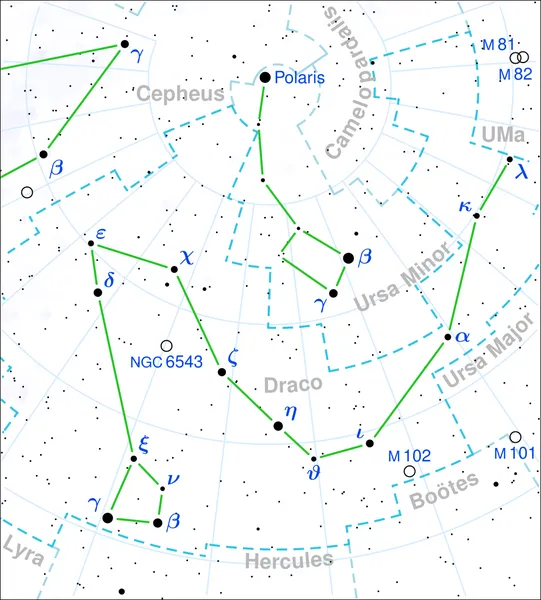
4 Draconis, also known as HR 4765 and CQ Draconis, is a star about 570 light years from the Earth, in the constellation Draco. It is a 5th magnitude star, so it will be faintly visible to the naked eye of an observer far from city lights. It is a variable star, whose brightness varies slightly from 4.90 to 5.12 over a period of 4.66 years. In 1967, Olin Eggen discovered that 4 Draconis is a variable star, during a multicolor photometric survey of red stars. In 1973 it was given the variable star designation CQ Draconis. Until the year 1985, 4 Draconis was thought to be a normal red giant star. In 1985, Dieter Reimers announced that the International Ultraviolet Explorer had detected a hot companion to the red giant, which itself appeared to be a binary cataclysmic variable star, making the complete system a triple star. However a 2003 study by Peter Wheatley et al., who examined ROSAT X-ray data for the star, concluded that the hot companion was more apt to be a single white dwarf, rather than a binary, and that the white dwarf is accreting material from the red giant. There does not yet appear to be a consensus about the multiplicity; some later studies consider 4 Draconis to be a binary, and some a triple. In 1987, Alexander Brown announced that 6 cm wavelength radio emission had been detected by the Very Large Array. The strength of the radio emission was variable on a timescale of weeks to months. It is possible that an outburst of 4 Draconis was the "guest star" reported by Chinese astronomers in the year 369 CE, in the constellation Zigong.
Also on this shelf
Infrared Space Observatory.
Eugene Merle Shoemaker.
See also
Uncatalogued shelfText from Wikipedia; plate via Wikimedia Commons. Text CC BY-SA 4.0; plate freely licensed (see Commons). Source record. Images and catalogue data are reproduced from open-access collections.