Astronomy and Space
Gamma Cassiopeiae
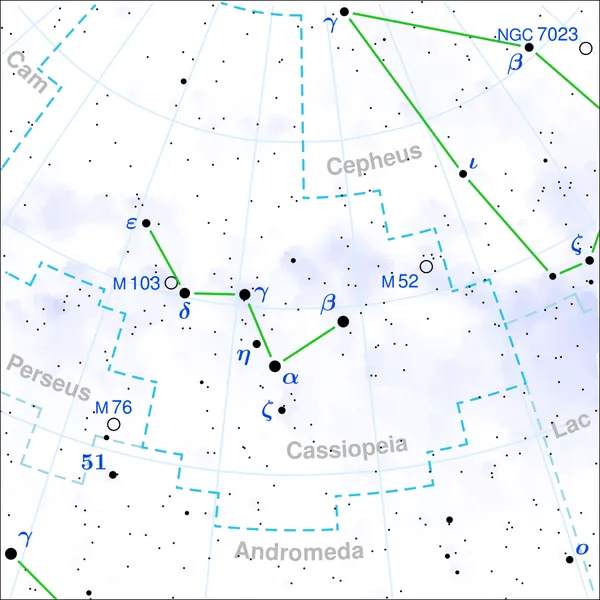
Gamma Cassiopeiae, also named Tiansi, is a multiple star system at the center of the distinctive "W" asterism in the northern circumpolar constellation of Cassiopeia. It was observed in 1866 by Angelo Secchi, the first star ever observed with emission lines. It is now considered a Be star. Gamma Cassiopeiae is a variable star system. Based upon parallax measurements made by the Hipparcos satellite, it is located at a distance of roughly 550 light-years from Earth. Together with its common-proper-motion companion, HD 5408, the system could contain a total of eight stars. It is one of the highest multiplicity systems known.
Also on this shelf
Apus.
Kepler-452b.
See also
Uncatalogued shelfText from Wikipedia; plate via Wikimedia Commons. Text CC BY-SA 4.0; plate freely licensed (see Commons). Source record. Images and catalogue data are reproduced from open-access collections.