Astronomy and Space
Comet nucleus
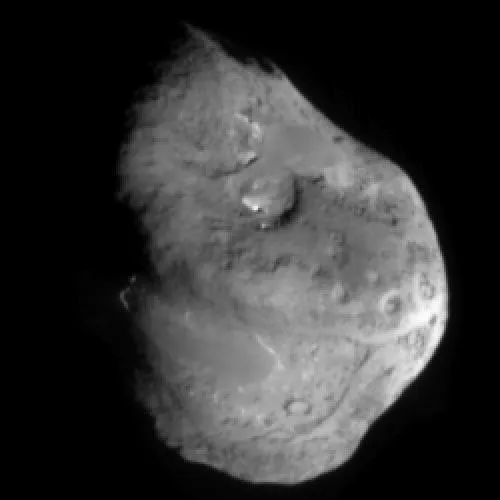
The nucleus is the solid, central part of a comet, formerly termed a dirty snowball or an icy dirtball. A cometary nucleus is composed of rock, dust, and frozen gases. When heated by the Sun, the gases sublime and produce an atmosphere surrounding the nucleus known as the coma. The force exerted on the coma by the Sun's radiation pressure and solar wind cause an enormous tail to form, which points away from the Sun. A typical comet nucleus has an albedo of 0.04. This is blacker than coal, and may be caused by a covering of dust. Results from the Rosetta and Philae spacecraft show that the nucleus of 67P/Churyumov–Gerasimenko has no magnetic field, which suggests that magnetism may not have played a role in the early formation of planetesimals. Further, the ALICE spectrograph on Rosetta determined that electrons (within 1 km (0.62 mi) above the comet nucleus) produced from photoionization of water molecules by solar radiation, and not photons from the Sun as thought earlier, are responsible for the degradation of water and carbon dioxide molecules released from the comet nucleus into its coma.
Also on this shelf
Beta Boötis.
4660 Nereus.
See also
Uncatalogued shelfText from Wikipedia; plate via Wikimedia Commons. Text CC BY-SA 4.0; plate freely licensed (see Commons). Source record. Images and catalogue data are reproduced from open-access collections.