Astronomy and Space
Explorer 33
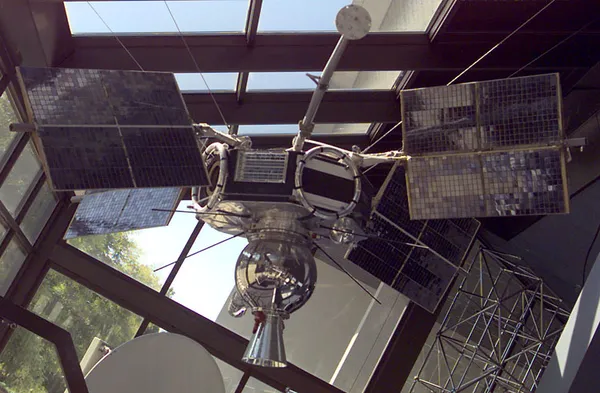
Explorer 33, also known as IMP-D and AIMP-1, is a spacecraft in the Explorer program launched by NASA on 1 July 1966 on a mission of scientific exploration. It was the fourth satellite launched as part of the Interplanetary Monitoring Platform series, and the first of two "Anchored IMP" spacecraft to study the environment around Earth at lunar distances, aiding the Apollo program. It marked a departure in design from its predecessors, IMP-A (Explorer 18) through IMP-C (Explorer 28). Explorer 35 (AIMP-E, AIMP 2) was the companion spacecraft to Explorer 33 in the Anchored IMP program, but Explorer 34 (IMP-F) was the next spacecraft to fly, launching about two months before AIMP-E, both in 1967.
Also on this shelf
Jupiter's South Pole.
Deep Space 2.
See also
Uncatalogued shelfText from Wikipedia; plate via Wikimedia Commons. Text CC BY-SA 4.0; plate freely licensed (see Commons). Source record. Images and catalogue data are reproduced from open-access collections.