Astronomy and Space
Huygens (spacecraft)
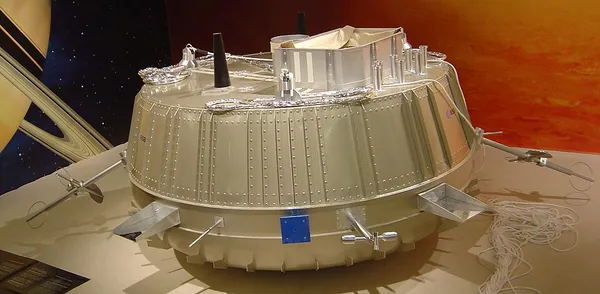
Huygens ( HOY-gənz) was an atmospheric entry robotic space probe that landed successfully on Saturn's moon Titan in 2005. Built and operated by the European Space Agency (ESA), and launched by NASA, it was part of the Cassini–Huygens mission and became the first spacecraft to land on Titan and the farthest landing from Earth a spacecraft has ever made. The probe was named after the 17th-century Dutch astronomer Christiaan Huygens, who discovered Titan in 1655. The combined Cassini–Huygens spacecraft was launched from Earth on 15 October 1997. Huygens separated from the Cassini orbiter on 25 December 2004, and landed on Titan on 14 January 2005 near the Adiri region. Huygens's landing is so far the only one accomplished in the outer Solar System and on a moon other than Earth's. Huygens touched down on land, although the possibility that it would touch down in an ocean was also taken into account in its design. The probe was designed to gather data for a few hours in the atmosphere, and possibly a short time at the surface. It continued to send data for about 90 minutes after touchdown.
Also on this shelf
Kepler-452b.
Aurora.
See also
Uncatalogued shelfText from Wikipedia; plate via Wikimedia Commons. Text CC BY-SA 4.0; plate freely licensed (see Commons). Source record. Images and catalogue data are reproduced from open-access collections.