Astronomy and Space
(202421) 2005 UQ513
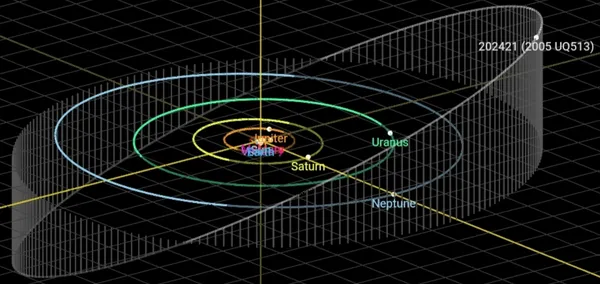
(202421) 2005 UQ513 is a large classical Kuiper belt object located in the trans-Neptunian region of the Solar System. It was discovered on 21 August 2005 by American astronomers Mike Brown, David Rabinowitz, and Chad Trujillo at the Palomar Observatory in California. Thermal observations by the Herschel Space Telescope estimate its diameter to be 498+63−75 km, which makes it among the top 34 largest known trans-Neptunian objects. It has a highly reflective geometric albedo of 0.202+0.084−0.049, which is higher than average for typical hot classical Kuiper belt objects. 2005 UQ513 completes one rotation relatively quickly every 7.03 hours. Visible spectroscopy observations show that 2005 UQ513 has a featureless spectrum with no detected absorption bands. However, its surface is very red due to a spectral slope of 18.1 ± 2.0%/100 nm, indicating a surface rich in complex organics. Models classify its orbit as dynamically stable over a period of 1 billion years. The Hubble Space Telescope is scheduled to observe the object in 2026 to search for potential moons. If a moon is found, it will allow scientists to directly calculate the mass and density of 2005 UQ513.
Also on this shelf
21 Persei.
High Energy Astronomy Observatory 1.
See also
Uncatalogued shelfText from Wikipedia; plate via Wikimedia Commons. Text CC BY-SA 4.0; plate freely licensed (see Commons). Source record. Images and catalogue data are reproduced from open-access collections.