Astronomy and Space
Farnese Atlas
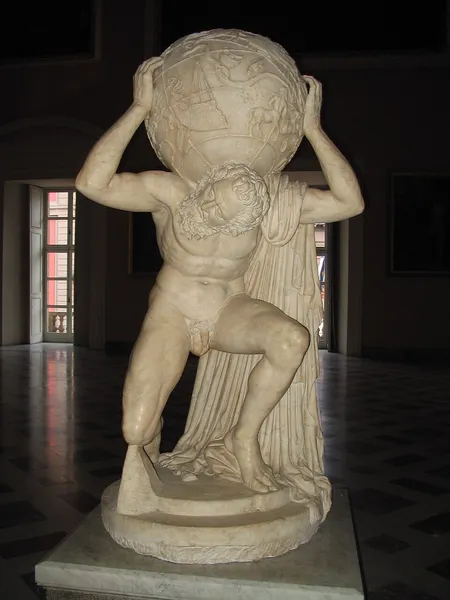
The Farnese Atlas is a 2nd-century CE Roman marble sculpture of Atlas holding up a celestial globe. Probably a copy of an earlier work of the Hellenistic period, it is the oldest extant statue of Atlas, a Titan of Greek mythology who is represented in earlier Greek vase painting, and the oldest known representation of the celestial sphere and the classical constellations. The sculpture is currently located at the National Archaeological Museum of Naples in Italy. The statue is dated around CE 150, during the Roman Empire and after the composition of the Almagest by Claudius Ptolemy, but the celestial globe has long been presumed to represent constellations mapped in earlier Hellenistic astrology, particularly in the work of Hipparchus in the 2nd century BCE. Atlas labors under the weight because he had been sentenced by Zeus to hold up the sky. The sphere shows a depiction of the night sky as seen from outside the outermost celestial sphere, with low reliefs depicting 41 (some sources say 42) of the 48 classical Greek constellations distinguished by Ptolemy, including Aries the ram, Cygnus the swan and Hercules the hero. The sculpture stands 2.1 meters (7 feet) tall, and the sphere is 65 centimeters (26 inches) in diameter. The name Farnese Atlas reflects its acquisition by Cardinal Alessandro Farnese in 1562, and its subsequent exhibition in the Villa Farnese.
Also on this shelf
Global Change Observation Mission.
Aerozine 50.
See also
Uncatalogued shelfText from Wikipedia; plate via Wikimedia Commons. Text CC BY-SA 4.0; plate freely licensed (see Commons). Source record. Images and catalogue data are reproduced from open-access collections.