Astronomy and Space
ISEE-2
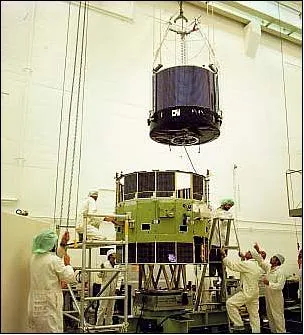
The ISEE-2 (International Sun-Earth Explorer-2, International Sun-Earth Explorer-B or ISEE-B) was part of the mother/daughter/heliocentric mission (ISEE-1, ISEE-2, ISEE-3). ISEE-2, an Explorer-class daughter spacecraft, was a 165.78 kg (365.5 lb) space probe used to study magnetic fields near the Earth. ISEE-2 was a spin-stabilized spacecraft and based on the design of the prior IMP (Interplanetary Monitoring Platform) series of spacecraft. ISEE-1 and ISEE-2 were launched on 22 October 1977, and they re-entered on 26 September 1987. The program was a cooperative mission between NASA and ESRO (later European Space Agency (ESA)), a memorandum of understanding (MOU) between NASA and the European Space Agency, was signed in March 1975. The program was designed to study the interaction between the Earth's magnetic field and the solar wind. At least 32 institutions were involved, and the focus was on understanding magnetic fields. ISEE-1 and ISEE-3 were built by NASA, while ISEE-2 was built by ESA. All three had complementary instruments supported by the same group of over 100 scientists.
Also on this shelf
Comet Hopper.
Beta Arae.
See also
Uncatalogued shelfText from Wikipedia; plate via Wikimedia Commons. Text CC BY-SA 4.0; plate freely licensed (see Commons). Source record. Images and catalogue data are reproduced from open-access collections.