Astronomy and Space
List of artificial objects leaving the Solar System
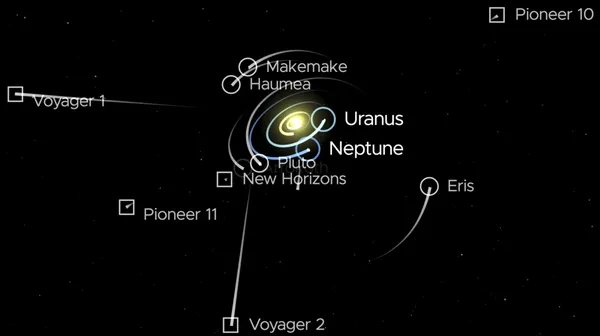
Several space probes and the upper stages of their launch vehicles are leaving the Solar System, all of which were launched by NASA. The borders of the Solar System are usually defined by the Heliopause diameter at about 120 astronomical units (AU; one AU is roughly the average distance between Earth and the Sun: 150 million kilometers (93 million miles)). Three of the probes, Voyager 1, Voyager 2, and New Horizons, are still functioning and are regularly contacted by radio communication, while Pioneer 10 and Pioneer 11 are now derelict. In addition to these spacecraft, some upper stages and de-spin weights are leaving the Solar System, assuming they continue on their trajectories. These objects are leaving the Solar System because their velocity and direction are taking them away from the Sun, and at their distance from the Sun, its gravitational pull is not sufficient to pull these objects back or into orbit. They are not impervious to the gravitational pull of the Sun and are being slowed, but are still traveling in excess of escape velocity to leave the Solar System and coast into interstellar space.
Also on this shelf
93 Leonis.
4MV.
See also
Uncatalogued shelfText from Wikipedia; plate via Wikimedia Commons. Text CC BY-SA 4.0; plate freely licensed (see Commons). Source record. Images and catalogue data are reproduced from open-access collections.