Astronomy and Space
Alouette 1
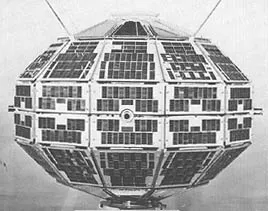
Alouette 1 is a deactivated Canadian satellite that studied the ionosphere. Launched in 1962, it was Canada's first satellite, and the first satellite constructed by a country other than the Soviet Union or the United States. Canada was the fourth country to operate a satellite, as the British Ariel 1, constructed in the United States by NASA, preceded Alouette 1 by five months. The name "Alouette" came from the French for "skylark" and the French-Canadian folk song of the same name. A key device on Alouette were the radio antennas consisting of thin strips of beryllium copper bent into a slight U-shape and then rolled up into small disks in a fashion similar to a measuring tape. When triggered, the rotation of the satellite created enough centrifugal force to pull the disk away from the spacecraft body, and the shaping of the metal caused it to unwind into a long spiral. The result was a stiff circular cross-section antenna known as a "STEM", for "storable tubular extendible member".
Also on this shelf
Delta (rocket family).
33 Cygni.
See also
Uncatalogued shelfText from Wikipedia; plate via Wikimedia Commons. Text CC BY-SA 4.0; plate freely licensed (see Commons). Source record. Images and catalogue data are reproduced from open-access collections.