Astronomy and Space
Chinese space program
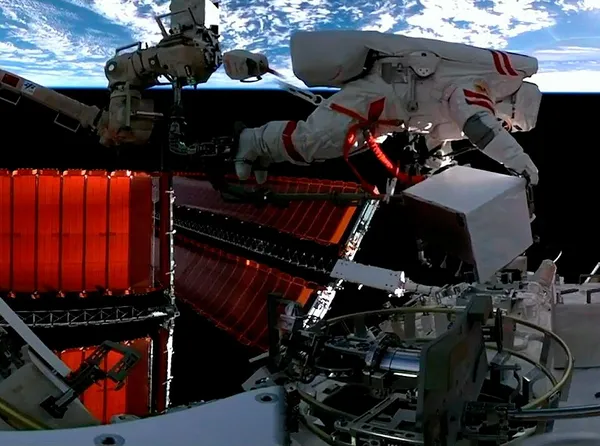
China has one of the most active space programs in the world. With launch vehicles of the Long March rocket family and four spaceports (Jiuquan, Taiyuan, Xichang, Wenchang), China conducts the most or second most orbital launches each year, and is one of three countries with a human spaceflight capability. China's fleet of over 1,300 Earth orbit satellites serves communication, navigation, reconnaissance and scientific research. China Manned Space Program operates Tiangong, one of two active space stations alongside the International Space Station (ISS). Most space operations are conducted by civilian China National Space Administration (CNSA) and the military People's Liberation Army Aerospace Force (PLAASF). CNSA has achieved robotic rover, lander, and orbiter missions to the Moon and Mars. PLAASF directs the Astronaut Corps and its Deep Space Network. From the 1950s, aided by the Soviet Union, development began on China's nuclear weapons, Dongfeng ballistic missiles, and Long March rockets, honored as the Two Bombs, One Satellite projects. Despite setbacks from the Cultural Revolution and Sino-Soviet split, China became the fifth country to independently launch a satellite, Dong Fang Hong 1 in 1970. China developed the Shenzhou crewed craft from Russia's Soyuz after a 1995 treaty; Shenzhou 5 carried the first Chinese astronaut in 2003. China commercially launched Western satellites from 1988, but failures, especially Intelsat 708, caused the US to embargo satellite export in 1998. After the US vetoed its joining the ISS, China began the Tiangong program, operating prototypes Tiangong-1 and -2 before the current Tiangong, the world's third modular space station. Since the 2020s, the program has been contrasted against Western space programs as the "New Space Race". China's Moon missions achieved the world's first far side landing (Chang'e 4), far side sample return (Chang'e 6), and longest-lived rover (Yutu-2). China's interplanetary missions deployed Tianwen-1, a Mars orbiter, lander, and the rover Zhurong; Tianwen-2 visited an asteroid in 2026 and will visit a comet in 2035. Its satellite constellations include BeiDou Navigation, Gaofen Observation, and the Guowang and Qianfan internet constellations.
Also on this shelf
8 Andromedae.
ESTRACK.
See also
Uncatalogued shelfText from Wikipedia; plate via Wikimedia Commons. Text CC BY-SA 4.0; plate freely licensed (see Commons). Source record. Images and catalogue data are reproduced from open-access collections.