Astronomy and Space
Climate of Titan
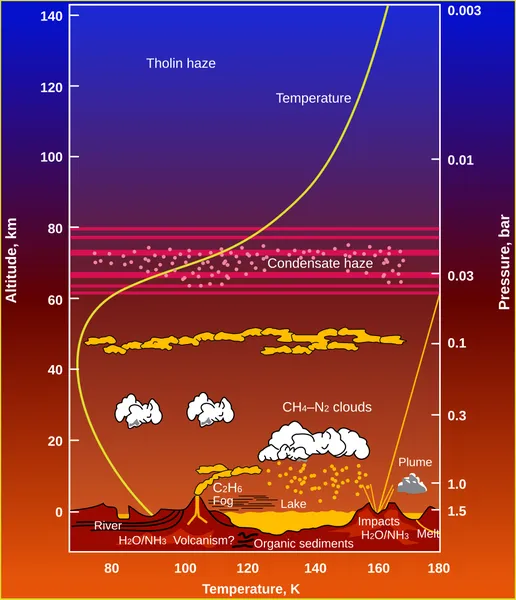
The climate of Titan, the largest moon of Saturn, is characterized by a thick atmosphere, a methane cycle, seasonal changes, and extremely low temperatures. Titan receives only about 1% as much sunlight as Earth and has an average surface temperature of about 94 K (−179.2 °C; −290.5 °F). Despite its cold surface, atmospheric methane produces a substantial greenhouse effect, while atmospheric haze produces an opposing anti-greenhouse effect. Titan's climate has several similarities to Earth's, including clouds, rainfall, lakes, atmospheric circulation, and seasonal changes, although methane and other hydrocarbons play roles analogous to those of water in many of its meteorological processes. Saturn's 29.5-year orbit around the Sun drives Titan's seasons, which influence its atmospheric circulation, cloud formation, rainfall, winds, and the distribution of surface lakes and seas. Titan's atmosphere also exhibits pole-to-pole circulation, with methane and ethane clouds occurring at different altitudes and latitudes. Titan's climate has been studied using observations from Earth and spacecraft, particularly the Cassini–Huygens mission, which provided detailed measurements of its atmosphere and surface. More recent observations by the James Webb Space Telescope and other observatories have continued to reveal seasonal cloud activity and other aspects of Titan's climate.
Also on this shelf
2867 Šteins.
Androgynous Peripheral Attach System.
See also
Uncatalogued shelfText from Wikipedia; plate via Wikimedia Commons. Text CC BY-SA 4.0; plate freely licensed (see Commons). Source record. Images and catalogue data are reproduced from open-access collections.