Astronomy and Space
Exoplanet
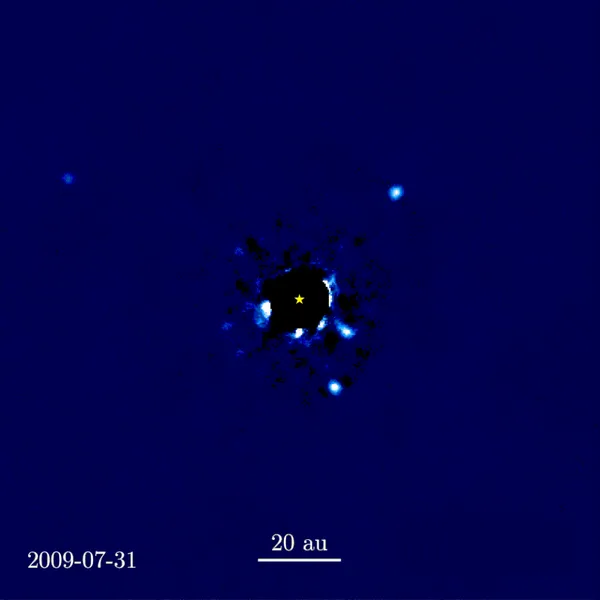
An exoplanet or extrasolar planet is a planet outside the Solar System. The first confirmed detection of an exoplanet was in 1992 around a pulsar, and the first detection around a main-sequence star was in 1995. A different planet, first detected in 1988, was confirmed in 2003. In 2016, it was recognized that the first possible evidence of an exoplanet had been noted in 1917, a precovery. As of 1 October 2026, there are 6,375 confirmed exoplanets in 4,772 planetary systems, with 1,064 systems having more than one planet. There are many methods of detecting exoplanets. Transit photometry and Doppler spectroscopy have found the most, but these methods suffer from a clear observational bias favoring the detection of large planets close to the star. About 1 in 5 Sun-like stars are estimated to have an "Earth-sized" planet in the habitable zone. Assuming there are 200 billion stars in the Milky Way, it can be hypothesized that there are 11 billion potentially habitable Earth-sized planets in the Milky Way, rising to 40 billion if planets orbiting the numerous red dwarfs are included. The least massive exoplanet known is Draugr, which is about twice the mass of the Moon. The most massive exoplanet listed on the NASA Exoplanet Archive is HR 2562 b, about 30 times the mass of Jupiter. However, according to some definitions of a planet (based on the nuclear fusion of deuterium), it is too massive to be a planet and might be a brown dwarf. Known orbital times for exoplanets vary from less than an hour (for those closest to their star) to thousands of years. Some exoplanets are so far away from the star that it is difficult to tell whether they are gravitationally bound to it. The nearest exoplanets are located 4.2 light-years (1.3 parsecs) from Earth and orbit Proxima Centauri, the closest star to the Sun. At the other extreme, there is evidence for extragalactic planets – exoplanets located in other galaxies. The discovery of exoplanets has intensified interest in the search for extraterrestrial life. There is special interest in planets that orbit in a star's habitable zone (sometimes called "goldilocks zone"), where it is possible for liquid water, a prerequisite for life as we know it, to exist on the surface.
Also on this shelf
Dracula's Chivito.
Charles Messier.
See also
Uncatalogued shelfText from Wikipedia; plate via Wikimedia Commons. Text CC BY-SA 4.0; plate freely licensed (see Commons). Source record. Images and catalogue data are reproduced from open-access collections.