Astronomy and Space
Cosmic dust
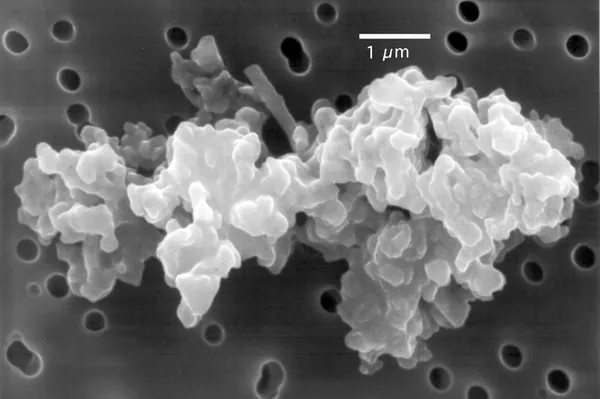
Cosmic dust – also called extraterrestrial dust, space dust, or star dust – is dust that occurs in outer space or has fallen onto Earth. Most cosmic dust particles measure between a few molecules and 0.1 mm (100 μm), such as micrometeoroids (<30 μm) and meteoroids (>30 μm). Cosmic dust can be further distinguished by its astronomical location: intergalactic dust, interstellar dust, interplanetary dust (as in the zodiacal cloud), and circumplanetary dust (as in a planetary ring). Information on the nature of dust in locations beyond the Solar System is mostly obtained by methods of observational astronomy, such as photometry, polarimetry and infrared spectroscopy. Direct methods are also available for the collection and study of space dust within the Solar System. For example, the Stardust spacecraft collected cometary dust, and also detected some particles of probable interstellar origin, returning samples to Earth in 2006. In the Solar System, interplanetary dust causes the zodiacal light. Solar System dust also includes cometary dust, planetary dust (e.g. from Mars), lunar regolith, asteroidal dust, dust from the Kuiper belt, and interstellar dust passing through the Solar System. Thousands of tons of cosmic dust are estimated to reach Earth's surface every year, with most grains having a mass between 10−16 kg (0.1 pg) and 10−4 kg (0.1 g). The density of the dust cloud through which the Earth is traveling is approximately 10−6 dust grains/m3. A major fraction of the dust in space is "stardust", consisting of refractory minerals such as silicates, graphite and amorphous carbon. These solids condense as circumstellar dust around evolved stars such as red giants, carbon stars, novae and supernovae, and are swept into interstellar space by the stellar winds and outflows of the parent star. The dust also contains organic compounds (amorphous organic solids with a mixed aromatic–aliphatic structure) that could be created naturally, and rapidly, in the outflows of carbon stars. or by processes occurring in the interstellar medium.
Also on this shelf
Epsilon Mensae.
Atlas (crater).
See also
Uncatalogued shelfText from Wikipedia; plate via Wikimedia Commons. Text CC BY-SA 4.0; plate freely licensed (see Commons). Source record. Images and catalogue data are reproduced from open-access collections.