Astronomy and Space
Fobos-Grunt
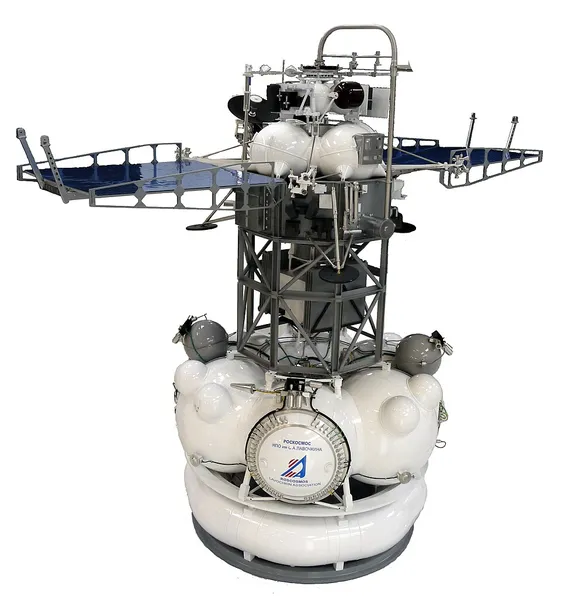
Fobos-Grunt or Phobos-Grunt (Russian: Фобос-Грунт, lit. 'Phobos-soil') was an attempted Russian sample return mission to Phobos, one of the moons of Mars. Fobos-Grunt also carried the Chinese Mars orbiter Yinghuo-1 and the tiny Living Interplanetary Flight Experiment funded by the Planetary Society. It was launched on 8 November 2011, at 20:16 UTC, from the Baikonur Cosmodrome, but subsequent rocket burns intended to set the craft on a course for Mars failed, leaving it stranded in low Earth orbit. Efforts to reactivate the craft were unsuccessful, and it fell back to Earth in an uncontrolled re-entry on 15 January 2012, over the Pacific Ocean, west of Chile. The return vehicle was to have returned to Earth in August 2014, carrying up to 200 g (7.1 oz) of soil from Phobos. Funded by the Russian Federal Space Agency and developed by Lavochkin and the Russian Space Research Institute, Fobos-Grunt was the first Russian-led interplanetary mission since the failed Mars 96. The last successful interplanetary missions were the Soviet Vega 2 in 1985–1986, and the partially successful Phobos 2 in 1988–1989. Fobos-Grunt was designed to become the first spacecraft to return a macroscopic sample from an extraterrestrial body since Luna 24 in 1976.
Also on this shelf
Albireo.
Gemini 4.
See also
Uncatalogued shelfText from Wikipedia; plate via Wikimedia Commons. Text CC BY-SA 4.0; plate freely licensed (see Commons). Source record. Images and catalogue data are reproduced from open-access collections.