Astronomy and Space
Exploration of Titan
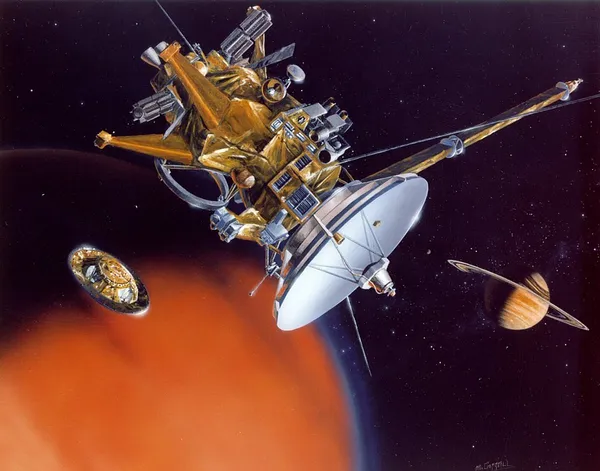
Titan, the largest moon of Saturn, is one of the most Earth-like worlds in the Solar System. It is the only moon known to have a dense atmosphere and the only world besides Earth known to have stable bodies of liquid on its surface. Its atmosphere consists primarily of nitrogen and contains methane, which cycles through clouds, rainfall, rivers, lakes, and seas. Titan's atmosphere and surface contain complex organic compounds of interest to planetary chemistry and prebiotic research. Beneath its icy crust, Titan is thought to have a subsurface ocean containing liquid water and ammonia. Exploration of Titan began with NASA's Pioneer 11 encounter with the Saturn system in 1979, followed by the Voyager 1 and Voyager 2 flybys in 1980 and 1981. These missions confirmed Titan's dense atmosphere while Voyager 1 showed that a thick haze obscures the surface. The Cassini–Huygens mission conducted the most extensive exploration of Titan to date, with Cassini making 127 close flybys between 2004 and 2017. Its radar and infrared instruments mapped the surface and investigated Titan's atmosphere, climate, organic chemistry, and interior, revealing a dynamic world with a methane weather cycle and a subsurface ocean. The Huygens probe, operated by the European Space Agency, became the first spacecraft to land on Titan in 2005 and remains the only spacecraft to have done so, returning the first direct measurements and images of its surface. It is also the most distant spacecraft to have landed on a planetary body. Future exploration is planned with NASA's Dragonfly mission, a rotorcraft lander scheduled for launch in 2028 and arrival in 2034. Dragonfly will demonstrate the first powered, fully controlled atmospheric flight on a natural satellite while studying Titan's geology, atmosphere, and organic chemistry at multiple locations, including environments that may preserve evidence of prebiotic chemical processes. It will investigate how the building blocks of life form and search for possible biosignatures or chemical evidence of habitability.
Also on this shelf
KOMPSAT-5.
Climate of Mars.
See also
Uncatalogued shelfText from Wikipedia; plate via Wikimedia Commons. Text CC BY-SA 4.0; plate freely licensed (see Commons). Source record. Images and catalogue data are reproduced from open-access collections.