Astronomy and Space
Hydrus
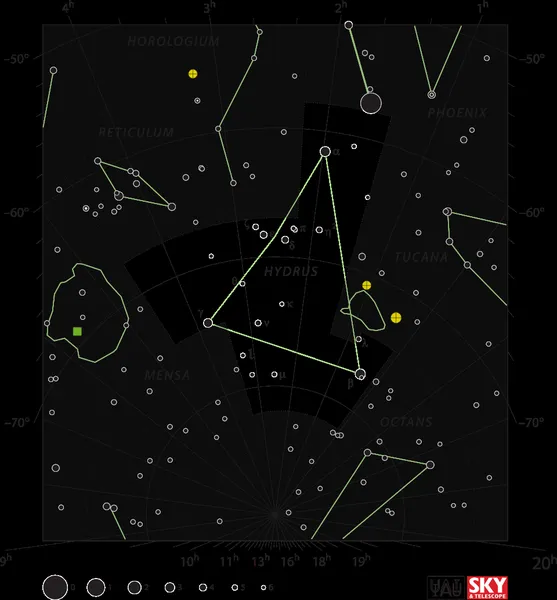
Hydrus is a small constellation in the deep southern sky. It was one of twelve constellations created by Petrus Plancius from the observations of Pieter Dirkszoon Keyser and Frederick de Houtman and it first appeared on a 35-cm (14 in) diameter celestial globe published in late 1597 (or early 1598) in Amsterdam by Plancius and Jodocus Hondius. The first depiction of this constellation in a celestial atlas was in Johann Bayer's Uranometria of 1603. The French explorer and astronomer Nicolas Louis de Lacaille charted the brighter stars and gave their Bayer designations in 1756. Its name means "male water snake", as opposed to Hydra, a much larger constellation that represents a female water snake. It remains below the horizon for most Northern Hemisphere observers. The brightest star is the 2.8-magnitude Beta Hydri, also the closest reasonably bright star to the south celestial pole. Pulsating between magnitude 3.26 and 3.33, Gamma Hydri is a variable red giant 60 times the diameter of the Sun. Lying near it is VW Hydri, one of the brightest dwarf novae in the heavens. Four star systems in Hydrus have been found to have exoplanets to date, including HD 10180, which could bear up to nine planetary companions.
Also on this shelf
Gravitational microlensing.
Caltech Submillimeter Observatory.
See also
Uncatalogued shelfText from Wikipedia; plate via Wikimedia Commons. Text CC BY-SA 4.0; plate freely licensed (see Commons). Source record. Images and catalogue data are reproduced from open-access collections.