Astronomy and Space
Interstellar travel
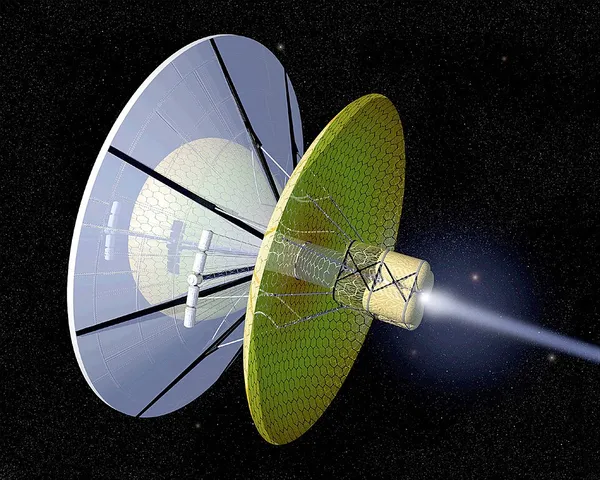
Interstellar travel is the hypothetical travel of spacecraft between star systems. Due to the vast distances between the Solar System and nearby stars, interstellar travel is not practicable with current propulsion technologies. To travel between stars within a reasonable amount of time (decades or centuries), an interstellar spacecraft must reach a significant fraction of the speed of light, requiring enormous amounts of energy. Communication with such interstellar craft will experience years of delay due to the speed of light. Collisions with cosmic dust and gas at such speeds can be catastrophic for such spacecraft. Crewed interstellar travel could possibly be conducted more slowly (far beyond the scale of a human lifetime) by making a generation ship. Hypothetical interstellar propulsion systems include nuclear pulse propulsion, fission-fragment rocket, fusion rocket, beamed solar sail, and antimatter rocket. The benefits of interstellar travel include detailed surveys of habitable exoplanets and distant stars, comprehensive search for extraterrestrial intelligence and space colonization. Even though five uncrewed spacecraft have left the Solar System, they are not "interstellar craft" in the sense that they are not purposefully designed to explore other star systems. Thus, as of the 2020s, interstellar spaceflight remains only a popular trope in speculative future studies and science fiction.
Also on this shelf
16 Virginis.
Algol.
See also
Uncatalogued shelfText from Wikipedia; plate via Wikimedia Commons. Text CC BY-SA 4.0; plate freely licensed (see Commons). Source record. Images and catalogue data are reproduced from open-access collections.