Astronomy and Space
List of European Space Agency programmes and missions
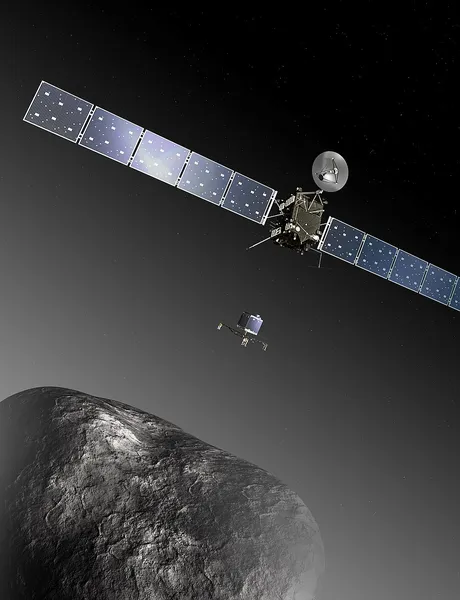
The European Space Agency (ESA) operates a number of space missions, both individually and in collaborations with other space agencies such as U.S. NASA, Japanese JAXA, Chinese CNSA, as well as space agencies of ESA member states (eg. French CNES, Italian ASI, German DLR, Polish POLSA). ESA organizes its missions into various budgetary programmes. This list follows the divisions of the Science Programme, the FutureEO Programme, and the Space Safety Programme. Missions from other programmes, such as Terrae Novae, FLPP, GSTP, or ARTES, are listed in loosely thematic categories. The current iteration of ESA's Science Programme is the Cosmic Vision Programme, a series of space science missions chosen by ESA to launch through competitions, similar to NASA's Discovery and New Frontiers programmes. It follows the Horizon 2000 and Horizon 2000+ programmes which launched notable missions such as Huygens (Titan lander), Rosetta (comet orbiter and lander), and Gaia (astrometry telescope). These missions are divided into two categories: "Sun and Solar System", space probes studying the Solar System (eg. Solar Orbiter studying the Sun and JUICE currently on its way to Jupiter) and "Astrophysics", space telescopes contributing to interstellar astronomy (eg. CHEOPS characterising exoplanets and Euclid focused on dark matter and dark energy). The Cosmic Vision Programme will be followed by Voyage 2050. A similarly operated programme focused on Earth observation, known as FutureEO, has launched various "Earth Explorer" satellites, which serve many aspects of Geoscience, often related to climate change. These include eg. GOCE and Swarm studying Earth's gravitational and magnetic fields, CryoSat-2 studying Earth's polar ice caps, and EarthCARE characterising clouds and aerosols in the atmosphere. The Earth Explorer missions are complemented by a series of smaller "Scout" satellites starting with HydroGNSS launched in late 2025. A number of Solar System, Astrophysics, and Earth observation missions by ESA have operated outside of these programmes, such as Giotto, Ulysses, Mars Express, Hipparcos, or Envisat. ESA also takes part in human spaceflight missions of other space agencies and commercial partners, eg. by providing European astronauts and major hardware components to the Space Shuttle, Mir, ISS, and Artemis programmes and supporting the Gaganyyan programme.
Also on this shelf
ET Virginis.
Arctic Weather Satellite.
See also
Uncatalogued shelfText from Wikipedia; plate via Wikimedia Commons. Text CC BY-SA 4.0; plate freely licensed (see Commons). Source record. Images and catalogue data are reproduced from open-access collections.