Astronomy and Space
Juno (spacecraft)
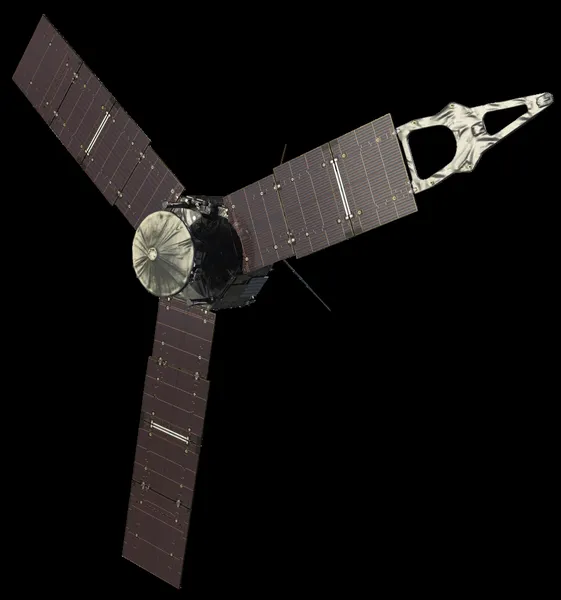
Juno is a NASA space probe orbiting the planet Jupiter. Built by Lockheed Martin and operated by NASA's Jet Propulsion Laboratory, the spacecraft was launched from Cape Canaveral Air Force Station on August 5, 2011, 16:25:00 UTC, as part of the New Frontiers program. Juno entered a polar orbit of Jupiter on July 5, 2016, 03:53:00 UTC, to begin a scientific investigation of the planet. After completing its mission, Juno was originally planned to be intentionally deorbited into Jupiter's atmosphere, but has since been approved to continue orbiting until contact is lost with the spacecraft. It will continue to explore Jupiter to study Jovian rings and the inner moons area, which is not well explored; this phase will also include close flybys of the moons Thebe, Amalthea, Adrastea, and Metis. Juno's mission is to measure Jupiter's composition, gravitational field, magnetic field, and polar magnetosphere. It also searches for clues about how the planet formed, including whether it has a rocky core, the amount of water present within the deep atmosphere, mass distribution, and its deep winds, which can reach speeds up to 620 km/h (390 mph). Juno is the second spacecraft to orbit Jupiter, after the RTG-powered Galileo orbiter, which orbited from 1995 to 2003. Unlike all earlier spacecraft sent to the outer Solar System and beyond—which used radioisotope thermoelectric generators for power—Juno is powered by solar panels, more commonly used by satellites orbiting Earth and working in the inner Solar System. Accordingly, Juno required the three largest solar panel wings ever deployed on a planetary probe (at the time of launching). These play an integral role in stabilizing the spacecraft as well as generating power. As of August 6, 2026, Juno remained operational and in contact with Earth through the NASA Deep Space Network.
Also on this shelf
110 Virginis.
CAESAR (spacecraft).
See also
Uncatalogued shelfText from Wikipedia; plate via Wikimedia Commons. Text CC BY-SA 4.0; plate freely licensed (see Commons). Source record. Images and catalogue data are reproduced from open-access collections.